I worked with a client who could drive calmly around his own city.
He drove to work, ran errands and used familiar streets. The car itself was not forbidden territory.
But he could not drive beyond the city boundary.
His panic attack had happened while travelling from one city to another. Afterwards, driving inside the city was possible; crossing the boundary was not.
Very precise magic.
On one side of an invisible line, he was an adult who knew how to drive. Beyond it, the whole structure changed.
The city boundary knew nothing about him. His reaction did.
A place can acquire a new meaning after an attack
The attack ends, but the person remembers more than the reaction itself. They remember where it happened:
- the road;
- the plane;
- the lift;
- the shop;
- one section of a route;
- the city boundary.
Then an understandable idea appears: *If I do not go there, it cannot happen again.*
I regard this initial avoidance as a normal response to an overwhelming fright. It does not mean preserving it forever is useful. It means the person is doing the best thing currently available to them: removing the place linked with panic.
Life can shrink very selectively
Avoidance gradually reduces the territory that feels permitted.
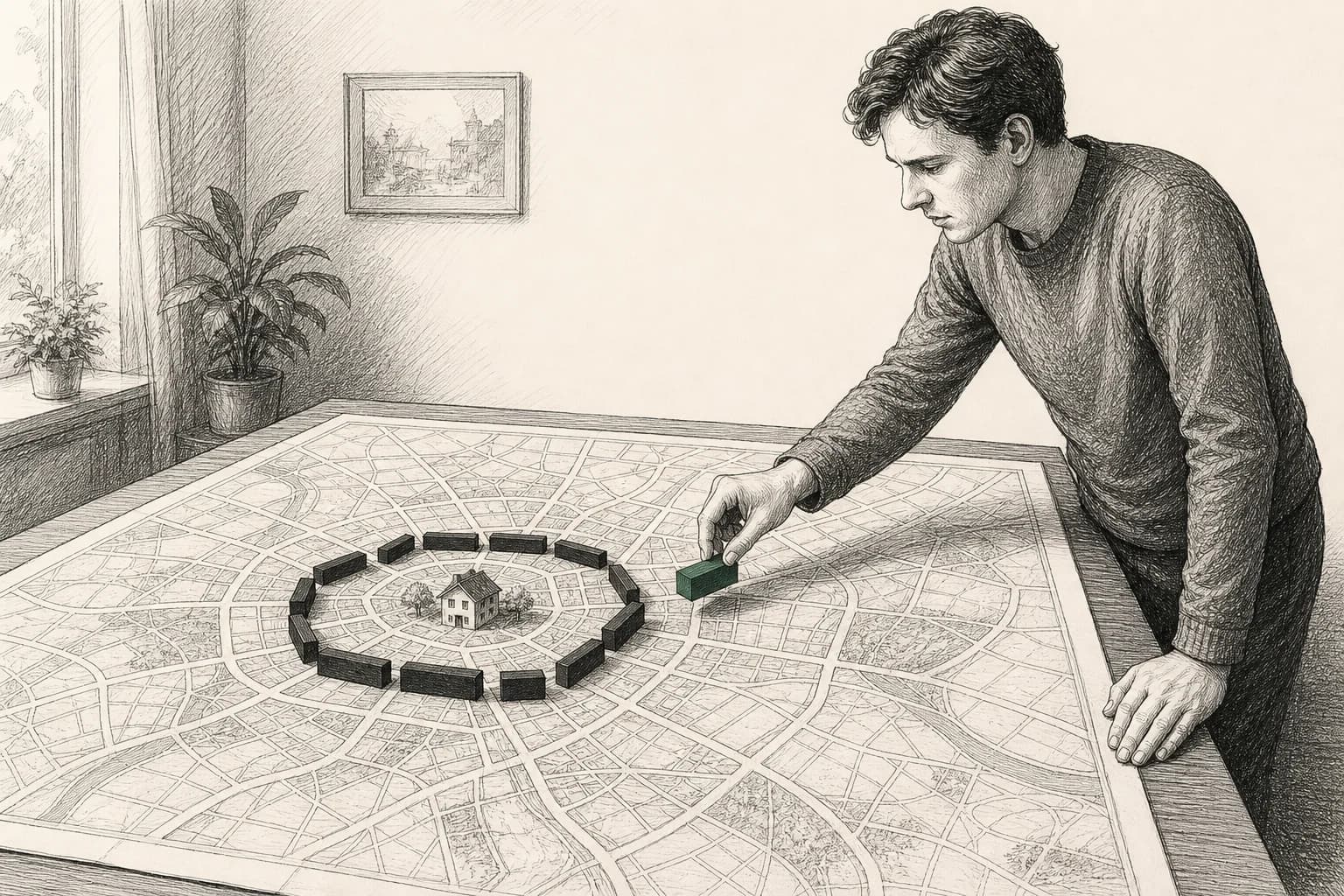
This client did not stop driving altogether.
Calling it “fear of cars” would have been too crude. The car functioned perfectly well inside the city. Work, familiar streets and ordinary tasks remained available.
One precise part of the territory had disappeared.
After panic, life does not always close completely. Sometimes it contracts around a very exact boundary. Someone may fly one route but avoid another, drive through town but not on the motorway, or enter every shop except the one where the attack occurred.
I do not make this a universal law. One attack does not have to spread to every car, plane, lift and road. The question is which context became linked with the response for this person.
Avoidance quickly becomes a rule
As long as the person does not approach the boundary, they may feel relatively calm.
That calm is easy to mistake for a result.
I have not had a panic attack for a long time.
Good. Have you travelled to the place where it used to begin?
No. I never go there now.
Then, so far, we know only that the avoidance rule works.
Avoidance can reduce encounters with the response. If a button is never pressed, no alarm is heard. But the available life becomes smaller at the same time.
I do not count the absence of panic inside a perfectly fenced enclosure as a complete result.
First, we work with what became linked to the attack
I did not immediately send this client onto a long-distance drive as a character-building exercise.
First, we worked with memories of the attack and the connected material.
The order matters. If everything that started the old response is still active, a heroic journey can become one more frightening scene in the same chain.
First, the person needs to regulate their state. Then the connected material needs to stop producing the old reaction when tested.
Only then does the question of return become useful:
Can the person use the part of life they lost?
The first test happened in imagination
The client first imagined crossing the city boundary and driving to the nearest town.
Not across the country. Not to prove his courage to the universe. One short, understandable route.
What happened as he travelled through it in his mind? Did the old prohibition begin? Did anticipation of an attack appear? Could he imagine completing the route without the former response?
An imagined test does not replace life. It shows whether this route is ready for a real test or whether the material remains active before the journey even begins.
If everything is still firing in imagination, I do not need a stirring report about bravery. I need more work with the reaction.
Then came a short real-life test
Once the short route became available in imagination, the next step was an actual journey.
I do not turn one client's route into a universal self-exposure protocol. A road remains a road. Traffic rules, physical condition, weather and the practical safety of the journey do not disappear because emotional work is taking place.
The purpose of the test is different: not to prove how convincingly the result can be described, but to see whether the action has returned.
Did the person cross the former boundary? Complete the short route? Spend the entire journey fighting the expected attack—or find that the old sequence did not begin?
Conversation cannot establish that. The road can.
A longer distance comes after a shorter one
After the nearest town became accessible in imagination, we introduced a longer distance. Later came a longer real-life test.
The magic here is impressively dull: begin with what is available, then take the next step.
Not because a longer road is permanently more dangerous, but because we need honest information about where the old response has ended and where it remains active.
A successful short route proves the short route. It does not automatically liberate every road, plane and lift in the world.
If a longer route starts the reaction again, the earlier result was not fake. A new, specific target has appeared. We work with it and test again.
An imagined route does not issue a driving licence for reality
A person can travel calmly in imagination and meet a different reaction in real life.
That is not a failed test. It is new information.
Imagination showed that one part was available. Reality revealed an element we had not yet seen. The answer is not to push harder and pretend the person lacks willpower. It is to identify what appeared and continue working with it.
The reverse is also true: a calm picture in the mind is not yet recovered territory.
Until the person safely does what they had been avoiding, we have preparation for a result—not the whole result.
First, establish whether the situation is actually safe
Not every avoidance is an old emotional reaction.
A road may genuinely be dangerous. Someone may be physically unfit to drive. There may be an external reason not to fly, travel or enter a particular place.
My technique does not repair roads, change weather or overrule reality.
The aim is not to make someone enter any situation and call that freedom. It is to remove an old automatic prohibition where that prohibition has narrowed life, then assess the real situation with a clear mind.
The result is recovered territory, not bravery
This article is not about every part of the panic story.
The first article showed how a small final event can cross a threshold after prolonged overload. The second showed how panic itself becomes a new frightening scene and creates anticipation.
Here, the question is practical:
Has the territory removed after the attack returned?
First, the short route no longer starts the old response in imagination. Then it is completed safely in life. Next, a longer distance is tested.
Eventually, the former boundary no longer decides where the person's available life ends.
They can travel, decline to travel or choose another route for real reasons. The city limit simply loses its curious second job as a representative of old panic.