Someone tells me:
I do not understand why it started. I was simply driving. Or standing in a shop. Or getting ready for an ordinary meeting. Nothing frightening was happening—and suddenly I had a panic attack.
Then they search the final five minutes for an explanation.
What did I see? What was I thinking? What did I eat? Who called me? Why there?
The logic is understandable: if the reaction began now, surely the cause must be somewhere nearby.
In my work, it often looks different. The final situation may be the smallest event in the whole story.
A panic attack can begin after something tiny
One person has been overloaded at work for months. Another is dealing with a difficult home situation while caring for an ill relative. A third has small children and almost no sleep. Sometimes several major events are happening at once, because life occasionally mistakes scheduling for a competitive sport.
The person somehow manages each individual demand.
Then one small thing happens—and a panic attack begins.
They look at that final event and say:
That cannot be the reason. It was nothing. I have survived things ten times worse.
Yes. They have.
That is precisely the point. They did not pass through those earlier events for free. Continuing to work, speak and fulfil obligations does not prove that every previous reaction has finished.
The last event does not have to create the whole reaction
The final small load lands on a system already carrying too much.
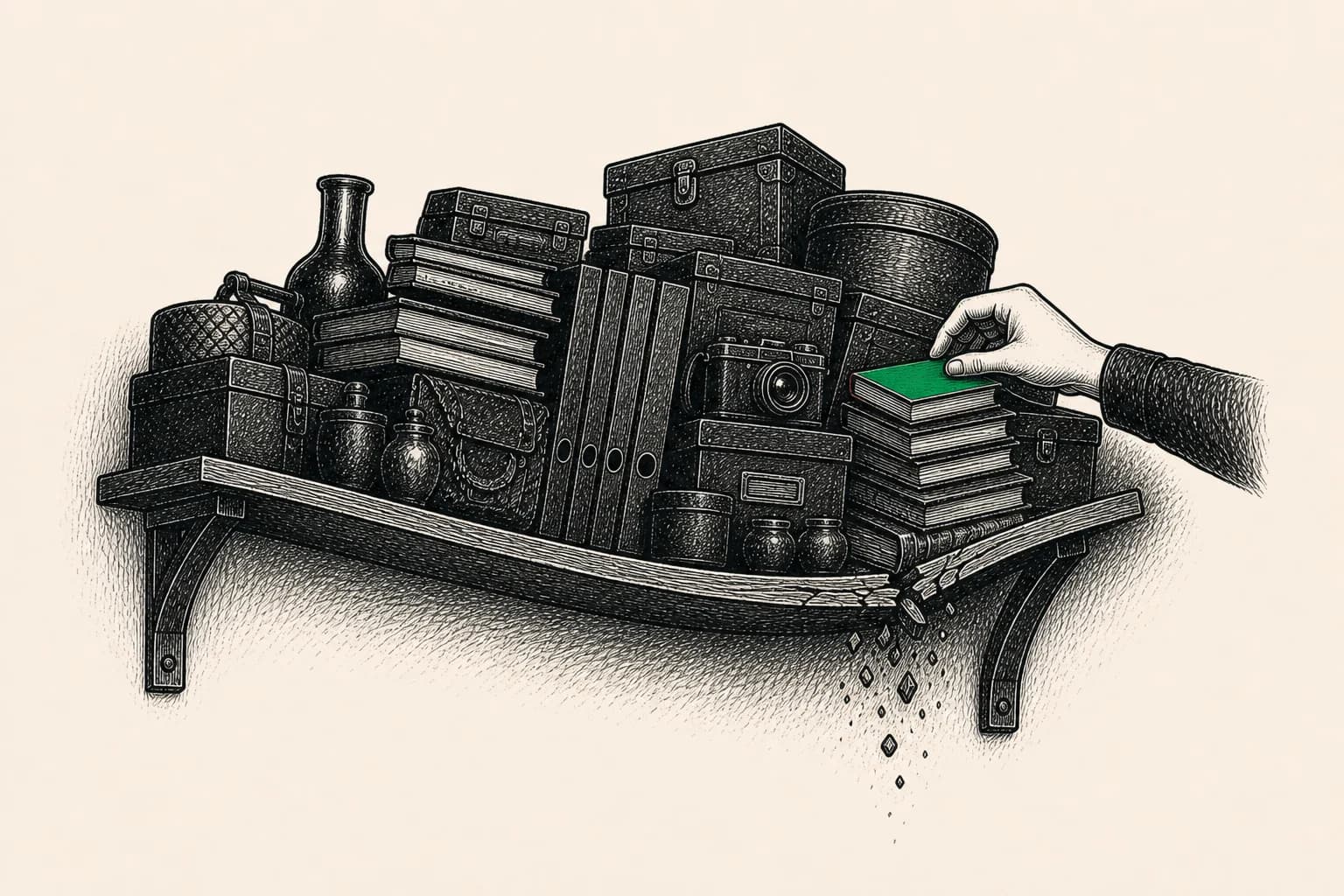
I sometimes explain this with imaginary numbers.
Suppose a person can carry 3.9 out of 5. That is already a lot, but the system is still holding.
Then something small is added. It becomes 3.91—and no longer holds.
These numbers are not a medical scale. They are an illustration.
The final hundredth did not create the earlier 3.9. It was simply where the threshold was crossed.
So the question “What happened immediately before the attack?” is useful, but incomplete. I ask more widely:
- When did this period begin?
- What was happening in the months before it—or the year before it?
- Where was the strongest overload?
- Which major events arrived one after another?
Often, a story begins to appear. It may not contain one dramatic scene. Different people have different backgrounds: work, family demands, illness, sleep loss or several large events that genuinely occurred together.
One plus one plus one somehow equalled eighty-five. Poor mathematics; real state.
“Suddenly” describes the moment, not necessarily the whole history
The attack may genuinely have felt sudden. The person is not inventing this, concealing an obvious cause or failing a test they did not know they were taking.
But *suddenly* describes how the attack entered conscious experience: things seemed normal, then abruptly became frightening. It does not prove that nothing significant had been building beforehand.
Someone may notice fatigue, irritation or anxiety and treat it as the normal price of life. They may carry an accumulated emotional background for years because, so far, they can.
We often call something normal when what we really mean is familiar.
If a person has lived at four out of five for a long time, they may say, “I am not particularly tense. I am always like this.”
Excellent. Four has acquired a job title and permanent building access. It is still not zero.
Overload is not my universal explanation
This model makes it tempting to produce a beautifully simple conclusion:
Panic attacks are always caused by accumulated overload.
I am not saying that.
Overload followed by a final small event is one route I encounter often. Another person may have one exceptionally intense episode, or a different history altogether.
I do not assign the cause in advance. The useful distinction is narrower: the final situation may not be the whole story.
I look beyond the day of the first attack
The first panic attack matters. The memory of it becomes material in its own right.
But if we work only with that day, we may miss everything that brought the system to that point. I look at several things:
- the period before the attacks began;
- difficult events happening around that time;
- the current level of real-life demand;
- what the person remembers about the first attack;
- what later developed around the possibility of recurrence.
This does not require years of biographical analysis or a definitive historical theory. I do not need a doctoral dissertation entitled *How I Arrived at the Supermarket Panic Attack*.
I need the material that remains active and helps maintain the pattern.
First, the person needs to regulate a rising reaction
I do not begin with the most difficult scene surrounding the attack.
First, the person learns to regulate what starts now: as soon as the reaction appears, use the hands.
When a reaction can be noticed and stopped, it becomes possible to work with more difficult material without being swallowed by it. This is not completion of the panic pattern. It is necessary preparation.
Then we return to specific memories around the period in which the attacks began.
Then we work with specific material, not the label “panic”
Once there is stability, the work can become precise.
Here is the memory of the first attack. What reaction appears now when it is imagined?
Here is an event several months earlier. What remains active there?
Here is the period of severe work or family overload.
Here is the small final incident that crossed the threshold.
One scene may be central. A chain may emerge. Or the final incident may become neutral while the earlier background still activates.
Then we continue.
Bulldozer first, scalpel second: begin with the obvious heavy material, then examine what specifically remains.
Reducing current stress helps, but it is not the whole result
If the person is still living under genuine overload, reducing that load matters. Against a quieter background, the reaction may arise less often.
But a calm week does not prove that the old panic pattern has finished. The practical question remains:
What happens when the person is again in a situation where the attack used to begin?
If the same rescue operation is required every time, we have improved regulation. That matters, but it is not the endpoint.
The test begins where the pattern used to begin
I do not count a good mood after a meeting as sufficient evidence. Understanding that overload was involved is not completion either.
We test more specifically.
The person imagines the first attack and deliberately checks for the old reaction. What happens?
They imagine a situation in which another attack once seemed likely. Does anticipation begin?
Then, with real safety taken into account, they return to life and observe whether the old sequence begins where it did before.
Stopping a reaction sooner is a result of regulation. A memory no longer producing its former charge is a result for that target. Returning to the real action without having to fight the same attack every time is a result in life.
One quiet week proves very little. Perhaps nobody pressed the relevant button.
The first attack opens the next question
Once the final small event is no longer treated as the sole cause, the story becomes more honest.
There may have been an accumulated background, several difficult events, a final threshold-crossing moment, and the first panic attack—which is now also a memory.
After that first attack, another problem can begin: the person starts waiting for the next one.
They have not yet entered the feared situation, but they can already imagine the entire sequence. The danger is no longer only the road, plane or shop. Their own possible reaction has become frightening.
That is a different mechanism, and it needs to be checked separately.