The first panic attack is over.
You exhale. It seems to be behind you.
Then a new thought appears:
What if it happens again?
Before the first attack, you may have feared a plane, a road, an enclosed space or another situation. Afterwards, there is a new object of fear: your own panic.
Now you are not only afraid of what might happen around you. You are afraid of experiencing again what has already happened inside you.
That is a distinct part of the pattern.
The first attack ends, but becomes a new memory
It is easy to think of a panic attack only as a reaction to an event.
There was a situation. Panic began. The situation ended, so surely everything should end with it.
But the panic itself was also a powerful event.
You remember where it happened, how you felt, what you thought and how you tried—and failed—to stop it.
I put this very directly:
For the body, the panic itself becomes a second event.
The first reaction did not merely pass. It left a scene that can now be remembered and anticipated. If panic happens again, there is a second scene, then perhaps a third. Each later attack begins with evidence that repetition is possible.
After the first time, anticipation becomes possible
The first attack ends; fear of the next one begins rehearsing it.
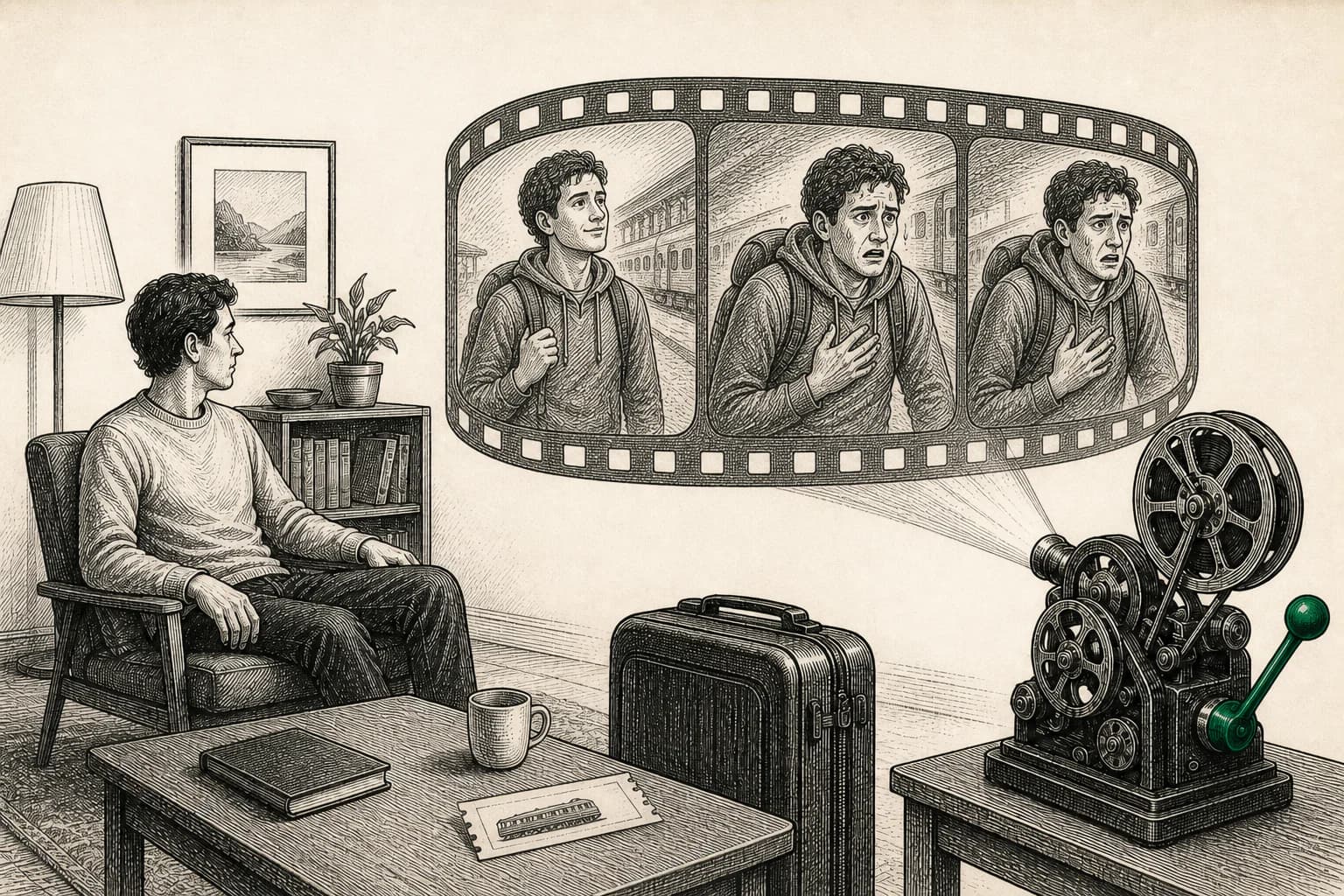
Before the first attack, you may not have known you could feel that way.
Afterwards, you know. The knowledge is not necessarily comforting.
It can turn into surveillance of the future:
- What if it starts again?
- What if I cannot stop it?
- What if it happens there?
You are not yet in the situation, but you are already imagining your reaction inside it.
That imagined future produces fear. You notice the fear and interpret it as confirmation: *There. It is starting already.*
You can enter panic before you enter the plane
Flying illustrates the mechanism clearly.
In one of my direct examples, an earlier enclosed-space fear became linked with a frightening incident on a plane when oxygen masks dropped. Later, an ordinary flight and a similar tone in the pilot's voice triggered the old response.
Then the experienced panic itself joined the chain.
The person plans to fly and imagines another attack.
They have not boarded. The pilot has said nothing. The plane is sitting somewhere else, behaving impeccably.
Yet the reaction has arrived.
The future has not happened, but the internal television is showing it with convincing production values. The body responds not to the real flight, but to the scene currently playing in the mind.
Anticipation does not cause every attack
This distinction should not become another universal theory.
I am not claiming that every later panic attack occurs only because someone expected it, or that every anxious thought inevitably becomes panic.
My position is narrower and more practical:
Anticipating another attack can help the reaction begin earlier and occur more often.
This needs to be tested in the individual case.
If someone imagines the future situation calmly and the old response does not appear, anticipation is not an active target at that moment.
If the body begins preparing for panic as soon as the person thinks about the journey, flight or meeting, the imagined future is participating in the pattern.
Stopping rising panic is not the same as removing anticipation
Learning to recognise the reaction earlier and reduce it is a major result. The person is no longer helpless; they have a tool.
But two outcomes are easily confused.
The first:
I imagined the future situation, panic began, and I managed to stop it.
The second:
I imagined the future situation, and the old panic sequence did not begin.
The first is regulation. The second means this particular part of the pattern has changed.
Regulation is necessary. It makes work with difficult material possible. But I do not declare the fire over merely because the person can now carry water faster.
The work may need more than the first attack
When panic has become a recurring pattern, the first scene may not be the only active one.
There can be:
- the memory of the first attack;
- memories of later attacks;
- difficult events and overload around the period when it began;
- anticipation of a future attack;
- fear of the anticipation itself.
These are different targets. I do not place all of them into one bag labelled *panic* and expect the entire bag to vanish after one successful exercise.
First, the person learns to regulate the response. Then we work with accessible difficult material and test the first scene, later scenes and the imagined future.
If one element becomes neutral while another still fires, the first piece of work was not pointless. The word *panic* simply turned out to name more than one button.
The future needs as honest a test as the past
Someone may say, “I understand now. It is only fear of the next attack.”
Good. Understanding helps.
Now imagine the future situation.
Do not give me an elegant explanation of why it should no longer be frightening. Actually picture it.
What happens? Does the old anticipation appear? Does the panic response begin? Is there an immediate need to escape it?
If so, the material is still active.
After the work, we test the same scene again—not a newly polished picture in which life is perfect, but the situation that used to trigger expectation. We deliberately check whether the former response can still be produced.
If it cannot, that is a result for this specific target.
Real life tests more than a good session
An imagined test matters, but life does not occur only in imagination.
The next test takes place where the old sequence used to begin. If flying is involved, the person goes through the real stages of travel. If it is driving, they return to the relevant situation, with actual safety fully considered.
I do not look only at whether they endured it once. I ask what happened internally.
- Did they spend the whole journey fighting the expected attack?
- Did the reaction begin and get regulated?
- Or did the old anticipation not begin at all?
Those are three different results.
Stopping the reaction shows regulation. No automatic start during an honest test shows change in that target. Acting freely in life shows that the result exists beyond the conversation.
Fear may already have become a rule for living
Even when anticipation no longer starts the old panic, life may not return automatically.
The person may already have stopped flying, driving on a particular road, crossing the city boundary, entering a certain shop or using a lift.
Fear of panic has become a rule:
Do not go there. Do not take this route. Do not cross that boundary.
Feeling calmer is not enough if the rule still decides what is possible.
The next question is concrete: has the lost action and territory actually returned?