One German shepherd bites someone.
It would be logical to fear that particular dog. It has already demonstrated its professional qualifications.
But the response may spread.
First, the person fears every German shepherd. Then every large dog. Eventually, every dog.
A new, small and peaceful dog has done nothing. It may be occupied with important dog business and have no idea that it has been appointed representative of an entire dangerous category.
The person, however, does not see only this dog. The established fear arrives with it.
Fear does not check an object’s biography
One frightening event can cast a common shadow over an entire category.
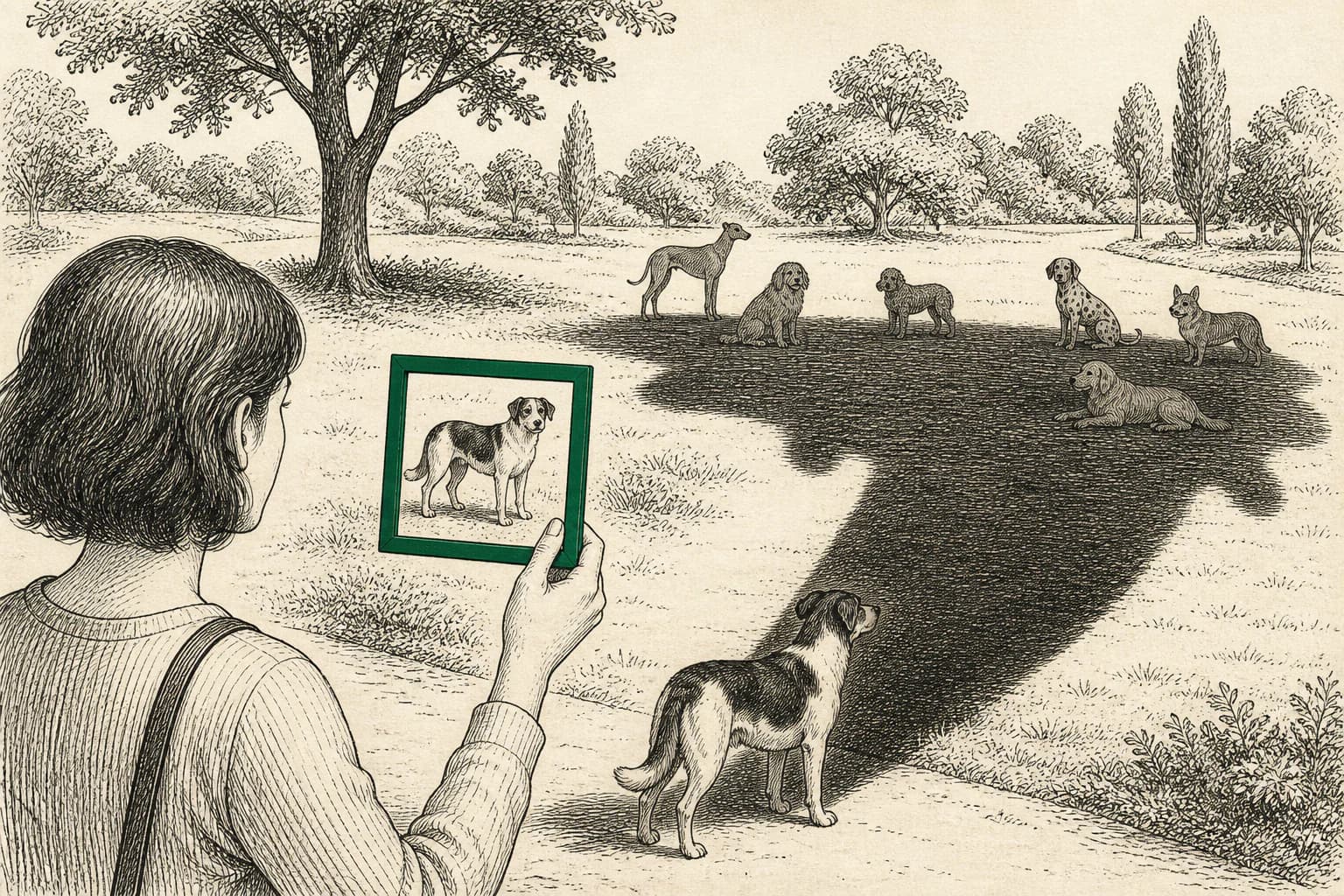
Consciously, the person may understand perfectly well:
- This is a different dog.
- It has never bitten me.
- It appears calm.
- Its owner has it under control.
An automatic response is not required to investigate every dog separately. It detects similarity.
The relevant similarity may begin with breed, then size, movement, sound, teeth or simply the fact that a dog is present.
There is no universal ladder that everyone follows. German shepherd, then large dog, then all dogs is one clear illustration. Each person’s category develops differently.
A safe member of the category does not cancel the old response
Latvia has venomous adders and harmless grass snakes. Someone sees a grass snake and experiences the full fear response.
The unfortunate snake has done nothing wrong. It has not acquired venom simply because the person is frightened.
But if the established rule is “snake means danger,” a currently harmless animal can press the old button.
The same is true of a dog. The first animal may genuinely have bitten or frightened the person. The next does nothing, but meets a response that is already prepared.
Two facts can be true at once: the present object may be safe, and the person’s response may be entirely real.
Every frightened encounter can join the history
After the first dog, the person meets another and becomes frightened again. The second dog does not bite, but the meeting is still stored as another episode of intense fear in the presence of a dog.
Then comes a third. A fourth. A gentle retriever. The neighbour’s tiny dog.
There may be no further dangerous event. The person’s own response keeps repeating.
So later work may involve more than the original bite. There is now a chain of situations in which the wider category activated fear.
This is why changing the response to the first dog does not necessarily change the whole category. The first scene and the generalised fear are related, but they are not always the same target.
Look at the whole category, not only its first member
If the problem now concerns more than one dog, there is little value in working indefinitely with a photograph of the original one.
Which dogs caused fear later? In which circumstances? Which details appeared similar? Which subsequent meetings became separate memories?
For one person, size matters. For another, the breed. For someone else, the response has spread to all dogs. Another person’s category may be organised around movement, sound or proximity.
The task is not to fit everyone into the correct dog template. It is to discover how this person’s response assembled the category and address the connected material.
The visible category may not be the real one
Lifts make this especially clear.
A person says, “I am afraid of lifts.” Further examination may reveal more than one lift: an old lift in which they became trapped, later journeys made while afraid, and an earlier experience of being locked in a cupboard as a child.
The relevant elements can include a closed bathroom door, possible darkness, the idea that a door will not open, standing before open lift doors, stepping inside, the doors closing and the movement beginning.
“Lift” is a convenient label. The box may contain much more.
This is not a mandatory sequence for every fear of lifts. It demonstrates the principle: the visible object can be one member of a broader connected category.
One calm image is not enough
After the work, I do not ask only whether the person now understands that this dog is safe. They may have understood that all along.
We return to the original scene. Can the former fear still be produced?
Then we check other members of the category: a large dog, a small one, a barking dog, and a specific safe future encounter that used to be unavailable.
If one image is calm and another still activates fear, that does not invalidate the first result. It shows its boundary. One element has changed; another has not.
Real-life testing belongs only in genuinely safe situations
An imagined check matters, but the final result has to exist in life.
That does not mean petting an aggressive dog, entering a broken lift or proving fearlessness beside a real danger. Emotional work does not abolish sensible caution.
In a situation that is actually safe, the person encounters a member of the category they previously avoided and observes what happens. Do they still have to fight themselves throughout? Can they choose what to do?
If a new response appears only in life, it becomes information for the next step—not an instruction to push harder.
The category should stop making the decision
I do not claim that changing one scene removes every fear of dogs, snakes, lifts and enclosed spaces.
I check something more specific. The original memory no longer starts the old response. Imagined safe members of the category no longer trigger automatic fear. A real, safe encounter becomes available without continuous internal struggle.
If a separate element remains, it receives its own name and becomes the next target.
Eventually, the person can distinguish reality again: this dog is calm; it would be wise to avoid that one. This lift is working; that one genuinely looks unsafe.
Choice returns to the object that is present today.
One German shepherd is no longer the official spokesperson for every dog in the world.