Someone says, “I feel anxious for no reason.”
I would not hurry to agree with the last three words.
That is not because the person is hiding something or has failed to investigate their childhood with sufficient enthusiasm. They may genuinely have no idea why they feel anxious. They open their eyes in the morning and the tension is already there. Nothing has happened. Nobody has called. Their manager has not written. The day has barely had time to put its shoes on.
Then the search for an explanation begins. Perhaps it is work. Money. The relationship. A child. The report that should have been finished yesterday. Perhaps it is simply their personality. Perhaps something is wrong with them.
They look for one cause because they feel one state.
But one state does not necessarily mean one source.
One state can contain several reactions
I look at unexplained anxiety a little differently.
Sometimes it is not one large anxiety that appeared from nowhere. It is several different responses running at the same time and merging into one background state.
You do not experience them as tidy folders with helpful labels. Internally, there is no dashboard saying: 35% manager, 20% money, 15% old memory, 30% imagined catastrophe.
It simply feels anxious.
And the more elements that are active together, the harder it becomes to distinguish one from another. So the person is being entirely honest when they say there is no reason.
The cause may not be invisible. There may be too many causes speaking at once.
Several things may be firing in parallel
I sometimes describe it this way:
Anxiety can resemble ten fears firing at the same time.
This does not mean that the person literally has ten phobias, or that ten is a diagnostically exciting number. One person may have three active lines, another nine, another fifteen. The number is not the point.
The point is that they are parallel.
One response starts around the manager. Another around unfinished work. A third around a difficult scene at home. A fourth around an image of having no money in the future. A fifth appears as a racing heart or another physical sensation. A sixth says, “Why am I so tired? There must be something wrong with me.”
Each can have its own history and its own trigger. Together, they do not feel like six small, comprehensible responses. They feel like one large, incomprehensible anxiety.
Past, present and future can all arrive today
Three different time zones can contribute to the same anxious background.
The first is the past. A manager says something ordinary, but the tone activates an older response to authority. You think about applying for a new job and previous rejections, critical teachers, difficult managers and old comments about your abilities all join the meeting without being invited.
The second is the present. The report is genuinely unfinished. There really is less money than you need. A difficult conversation in the relationship has not happened. Not all anxiety is fantasy. Sometimes it contains accurate information about a real task.
The third is the imagined future. You picture having no money six months from now and your body responds today. A child makes one poor decision and the parent’s mind has already produced a three-season documentary about how everything goes wrong.
The future has not happened. The image, however, is being shown to the body now, so the response also happens now.
Past, present and imagined future can therefore contribute to one state at the same time.
The response may connect things that look unrelated
People often try to build a beautiful logical chain. If I become anxious around my manager, the cause must be one story about a manager. If I fear public speaking, we need the first presentation. If I feel uncertain about finding work, the cause must be my previous job.
Not necessarily.
In my work, connected memories often appear according to a logic the conscious mind would never have proposed. A cluster around public speaking may contain a meeting, an exam, a poem recited at school and a critical parent years earlier. Anxiety around finding work may connect employer rejections, an old manager, something a former partner said and an injury that happened on the way to work.
The conscious mind looks at the list and asks what on earth these things have in common. The response has already filed them together.
That is why I do not require someone to explain their entire anxiety before work can begin. Sometimes inventing one perfect cause simply produces another story they now have to carry.
Finding the one root is a poor first assignment
It is tempting to search for the decisive event that explains everything.
Sometimes there is one powerful episode. Even then, further layers can gather around it: fear of the response itself, avoidance, another difficult experience, then an image of the next disaster.
More often, the structure is less elegant. Two years of overload at work, trouble at home, illness in the family, an old frightening experience and fear of the future may all be present before one small incident becomes the final addition.
Did that small incident create everything? Probably not. It may simply have completed a system that had been assembling for some time.
I do not need a perfect biography of the anxiety before I can examine its working structure now.
What exactly is firing?
The background has to be separated into parts
Several different responses can merge into one anxious background.
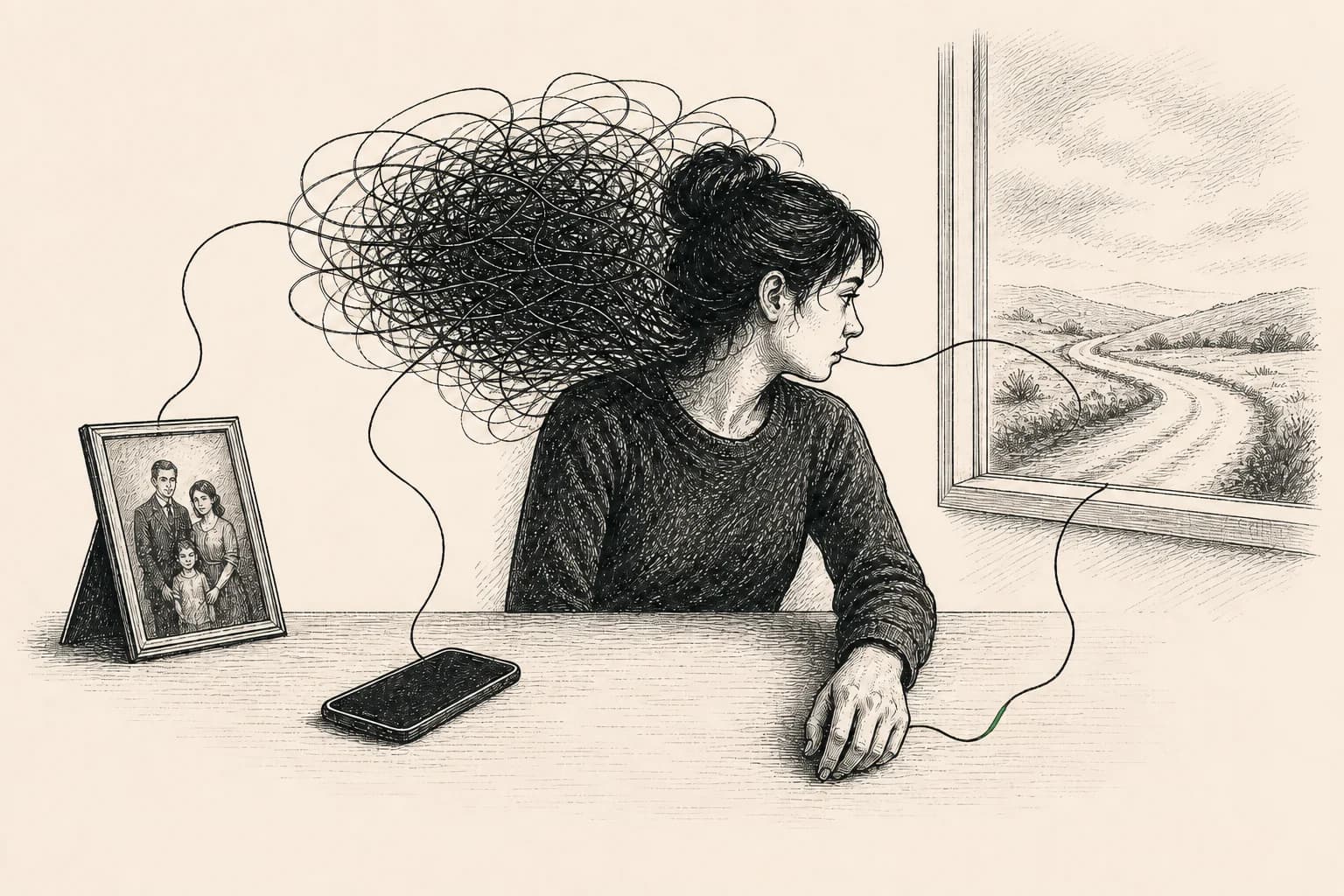
“I have anxiety” is too large a label to reveal what the state contains.
Is there a particular memory? An image of a bad future? A physical sensation? An unfinished task in the present? Anger at yourself for feeling anxious again? The thought that the anxiety proves something is wrong with you?
What looked like an endless fog can begin to separate into specific elements.
Naming them does not change them by itself. It does something more modest and useful: it makes precise work possible. You cannot work with “everything is terrible” as one object. You can work with a particular future image, a particular memory, a physical response or a real task that requires action.
Individual reactions can then be addressed
If several responses are active, I do not immediately choose the most frightening memory in the person’s life.
First, they learn Off-Switch and stabilization: how to notice and reduce the current response when it arrives. Then they work gradually with accessible memories and reactions. Later, we check which specific patterns remain active.
The order matters. A person needs a way to regain control before the heaviest material is allowed to set the pace.
Understanding the parts is not the result
There is another easy mistake. The person maps the whole background: manager, money, past relationship, future fear. Excellent diagram. Very organised anxiety.
But if the next email from the manager still tightens the body, the response is active. If picturing a financial problem removes the ability to think today, the response is active. If an old memory still produces the same emotion, giving it a good label has not placed it in the past.
Separation is the beginning of accurate work, not the end.
First, individual elements emerge from the general anxious state. Then the person learns to manage them, works with what continues to start them, and tests the change against the past, imagined future and real life.
How I work with this kind of anxiety
I do not try to treat ‘anxiety in general’, and I do not ask someone to arrive with a museum-quality catalogue of everything that has ever gone wrong. First, they learn the Off-Switch tool and how to stabilise one reaction while it is starting.
That does not mean the anxiety is finished. It means the person is no longer drowning in a single undifferentiated background and can see what we are working with next: a memory, a feared future, a body response or fear of the anxiety itself.
We take the thread that is available now and see what appears beside it. A present-day manager may bring up school. Money fear may uncover old rejection. The connection is not required to win an award for elegant logic.
First the bulldozer, then the scalpel.
I test the reaction, not the pleasant conversation
‘I feel better now’ is useful information, but it is not the final test. We return to the same memory or imagined future and see whether the old response still starts. Then ordinary life gets a vote.
If that target no longer activates, that target has changed. It does not prove that every line in the anxious background has disappeared. The next remaining element can now be seen and handled separately.
If the emotional response has changed but the bill still needs paying, the conversation still needs having or a new skill is missing, further emotional work is not a substitute for action.
“No reason” can mean “everything at once”
I am not claiming that every person’s anxiety is always organised this way. Nor should a real problem be dismissed as “just the past.”
If there is no money, something has to be done about the money. If the work is unfinished, a plan is needed. If there is real danger, useful anxiety should help you look around rather than disappear on command.
But when anxiety has become a constant background and no single reason explains it, consider this possibility: one state may contain several active elements.
They fire in parallel, and you hear the combined noise.
The task is not to give the noise one more impressive name. It is to separate what it is made of.
That leads to the next question: why can anxiety remain after the most obvious problem has been solved?