Someone walks into a child's bedroom.
There are clothes on the floor, a mug on the desk and a backpack lying where backpacks have always aspired to lie: in the middle of the doorway.
The person sees it and starts shouting.
Not, “Please tidy your room,” but a response appropriate to the destruction of their career, future and the final remains of civilisation.
Ten minutes later, they look again and know the mess was unpleasant—but the reaction was much larger than the mess.
The more interesting detail is that the room looked almost the same yesterday. Yesterday they complained and moved on. Today they exploded.
The room is similar. The children are the same. The clothes have probably not undergone a profound overnight transformation.
Why is the response different?
I do not argue with the facts of the present
The mess is real.
Perhaps the children promised to tidy and did not. Perhaps the adult has already asked five times. Rules, consequences and a firmer conversation may genuinely be needed.
I do not begin with the fashionable sentence, “This is all your past; the children have nothing to do with it.”
They do. They left the mess.
A manager may really use an unpleasant tone. A partner may break an agreement. A dog in the street may be genuinely aggressive rather than a decorative symbol of your childhood.
The present exists. Sometimes it requires a boundary, a demand, leaving, stopping someone or moving out of the path of a bus.
The second question is whether all the force of the response came from what is happening now.
The same mess meets a different threshold on different days
On one day, the person is rested, has completed an important task and feels unusually charitable towards the universe. They see the clothes and ask the children to tidy.
On another day, they arrive already overloaded. There has been conflict at work. Money is tight. Sleep has been poor for weeks. One child makes noise, another spills something, and somebody answers in exactly the wrong tone.
Very little is needed for the explosion.
So I separate the signal from the state in which the person meets it. The mess may be the same; the reaction threshold is not.
Current stress acts as an amplifier. But that may not be the whole story.
I would put a hundred euros on the body remembering more than this room
In my working model, the person may be reacting not only to the clothes scattered today.
I would put a hundred euros on the body remembering the same scene five days ago, two weeks ago, three months ago and two years ago.
Two years earlier, it may have occurred during a much more difficult period: shouting children, severe tension and other problems at home.
Today, a similar picture appears and the response does not arrive alone.
This is my working bet, not a statistic. I have not measured parents with specialist equipment and produced a peer-reviewed denomination of exactly one hundred euros.
Nor do I assume this history in every case. For one person the active signal is noise, for another disorder, for another the tone. In some cases today's situation will be the main fact and no large history will appear.
But when the response is clearly larger than one scene, I check whether the present has brought earlier material with it.
The present event becomes larger than itself
A small present-day signal can open a much larger old scene.
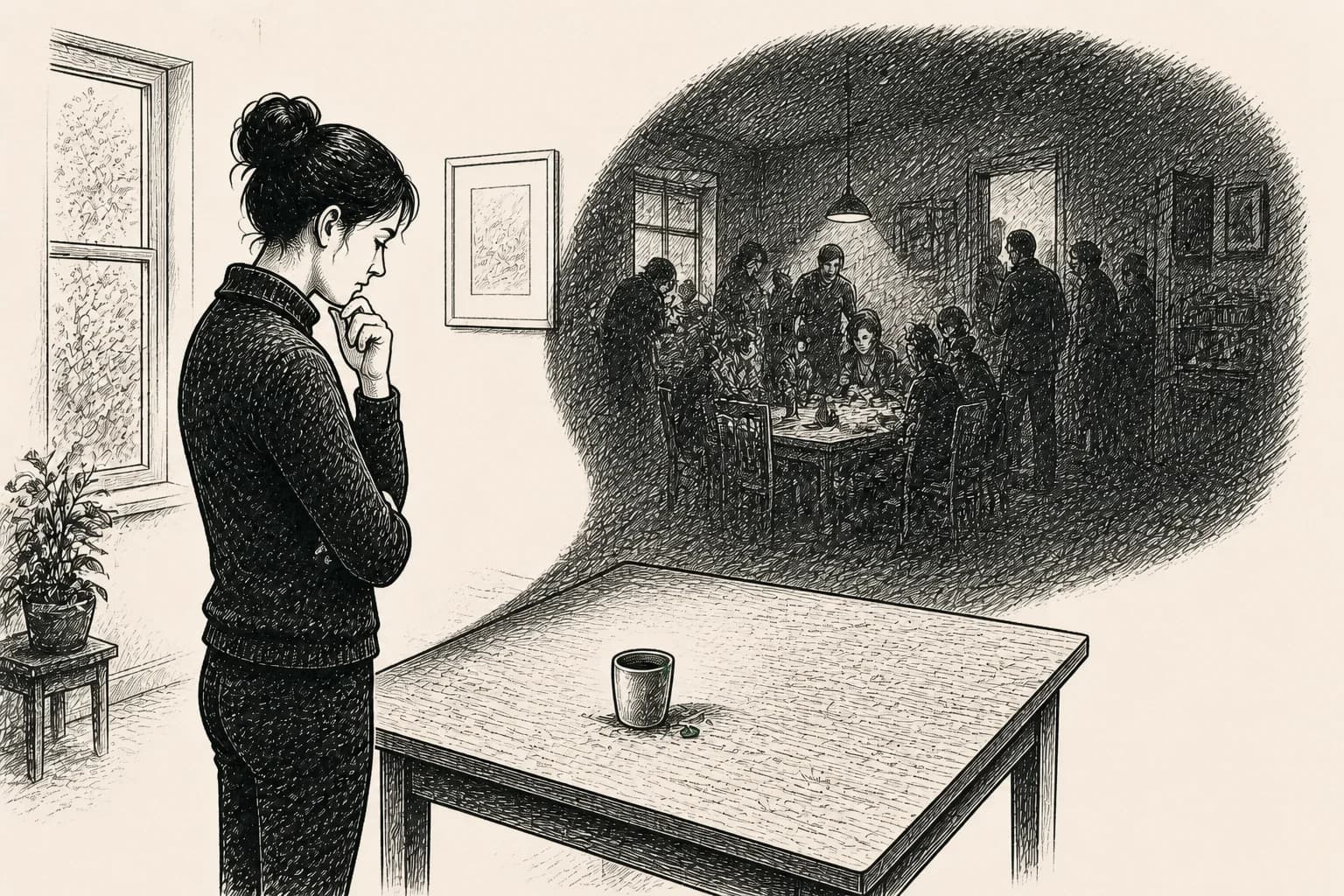
There is the room in front of the person. That is one layer.
There is the person's state today. That is another.
There may also be earlier situations in which a similar picture, sound or feeling accompanied anger, helplessness or overload.
Then today's scene carries additional weight. The person thinks they are answering one mug and one backpack, while accumulated material has joined the conversation.
The disproportion does not mean they are foolish, a bad parent or incapable of self-control. The system is performing the response it already knows in a similar situation.
The difficulty is that this response is fast and expensive for everyone involved.
The distinction is even clearer with a dog
One dog may once have frightened someone. Later, other dogs joined the sequence—some genuinely aggressive, others harmless but frightening at the time.
Today, a small calm dog approaches. Reality still comes first: is it restrained, calm and actually safe?
If there is no present danger but the entire former terror arrives, today's dog has started more than it created.
This does not mean all dogs are safe. It means the dog today and the response arriving with it need separate assessment.
Understanding may arrive after the reaction
After shouting, the person understands that the room was not a catastrophe. They may promise themselves to stay calm next time.
Then the door opens, the same mess appears—and body and emotion resume the old discussion before reason has found a chair.
The person can assess the situation correctly afterwards and still react too strongly inside it. We therefore need to test the response, not merely the quality of the explanation.
I test one specific scene
I do not announce that we will now discover which childhood trauma causes shouting at backpacks.
We take the actual scene: this room, these objects, this moment of entering. What happens in the body and emotion? What exactly fires—the image, noise, tone, loss of control or something else?
We work with the accessible material connected with that response, then return to the same scene and deliberately test it again.
If the automatic explosion returns, the work is not complete. If it does not, we have a result for that scene—not for all human anger, the entire biography or every possible conversation with the children.
One tested scene.
Less old charge does not make today's behaviour acceptable
The room does not have to become beautiful after the old response reduces.
The adult may still require it to be cleaned, refer to the agreement or set an unpopular consequence.
The difference is not blissful approval of everything in the house. It is answering today's situation with today's action instead of handing the children the accumulated archive.
The same applies to actual danger and real mistreatment. Calm does not make an aggressive dog safe or a humiliating manager good. It makes the present facts easier to assess and the action easier to choose.
How I work with a response that is larger than today’s event
I do not argue that the present event is harmless. I measure its facts and the size of the response separately, then choose one scene that appears to be adding more weight than today can account for.
After working with that scene, I return to the same current mess, tone or mistake. The present facts should still be visible. What changes is the extra historical force that made them occupy the whole room.
A smaller response does not declare today’s behaviour acceptable. It makes today’s behaviour today-sized again.
The final test comes when a similar event occurs in life. Can the person respond to what happened, set a boundary or repair the problem without the older scene taking command?
The next real mess will show more than a good conversation
After the work, the person imagines the room and tests for the old reaction.
Then life supplies the real test. The children do not become perfect for research purposes. The backpack returns to the doorway. Someone uses the wrong tone.
If the person sees the fact, maintains the boundary and chooses an action without the automatic explosion, the change exists beyond the meeting.
The aim is not the absence of every emotion. A mess can irritate; danger can frighten; a broken agreement can anger.
The result is that the scale of the response moves closer to the facts of the present—and choice remains available.