Someone begins working with one memory: an unpleasant conversation at work, involving a particular person, phrase and response.
Then a school examination appears. Or a teacher. Or an entirely different situation, age and person who looks nothing like the present manager.
The first question is usually:
What does this have to do with anything?
A good question. I do not necessarily need the answer immediately.
It matters more to avoid inventing a beautiful story and observe what actually appears—and what happens to the response.
I begin with one accessible episode, not the entire biography
People sometimes worry, “I remember almost nothing. How can I work?”
I do not need a complete biography at the beginning.
There is no requirement to inventory life from birth, remember every bad Friday or identify the earliest event in advance.
We take one episode available now. Not “my terrible childhood,” “all bad managers” or “I always fear public speaking.” One scene, one moment and one response that can be produced and tested.
The work begins with what can genuinely be imagined now—not with the completeness of the narrative.
Another episode may appear during the work
One scene can bring another, or several at once.
The person may begin with a work meeting and remember an examination; begin with fear of applying for a job and remember a rejection, an old manager, a friend's comment or a physical incident they would never have placed in the same folder.
The next scene may be from another period with different people. The conscious connection may seem strange.
This does not mean every random thought becomes the Grand Cause of Everything. I treat the episode as potentially connected material: record it, then test it later rather than building a life theory immediately.
Pull one thread and a chain may follow
One scene can draw several connected memories into view.
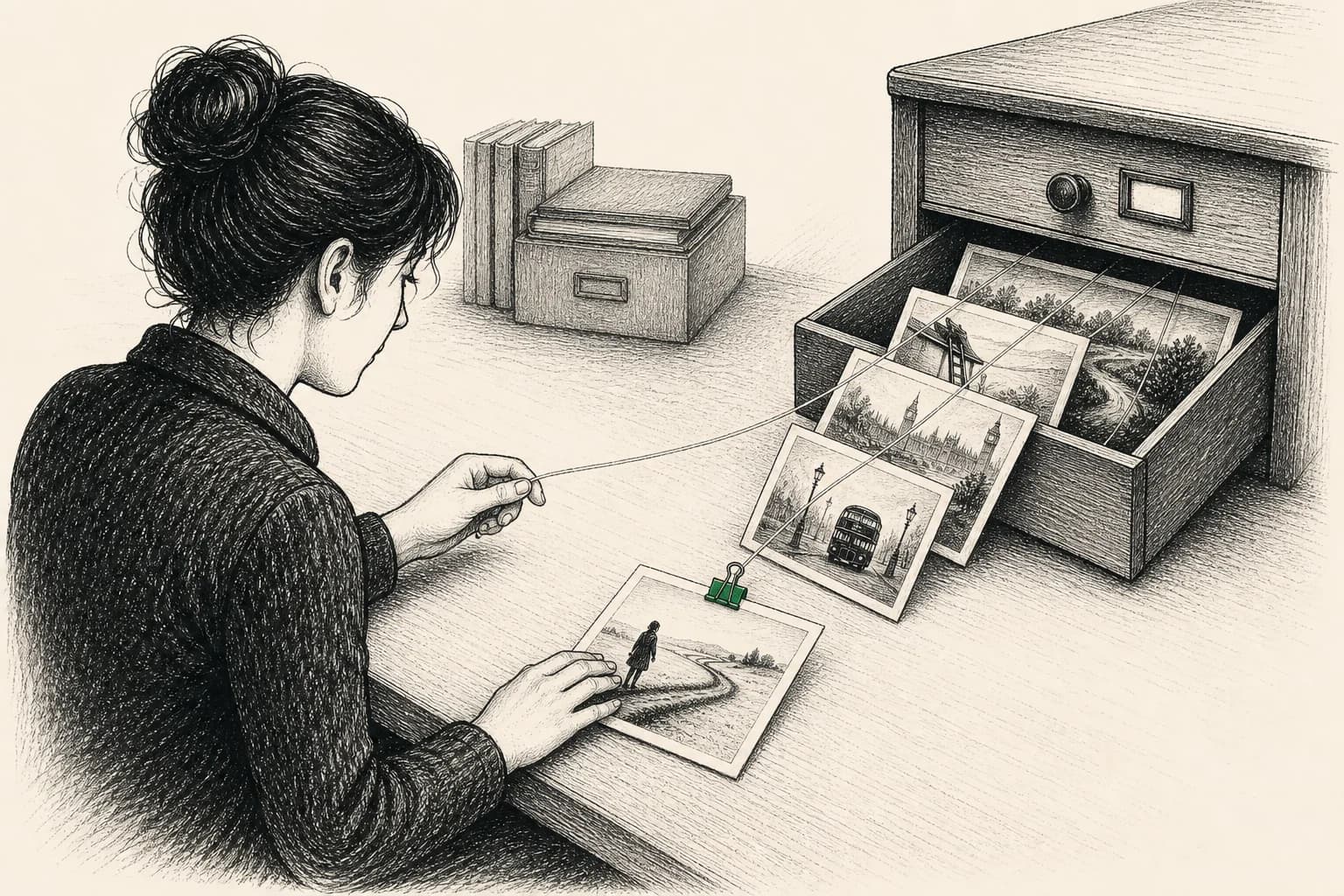
This is how I explain it:
Pull one thread, and a chain may follow.
One accessible memory can open another, then another. The sequence does not have to be tidy or chronological.
Fear of speaking may connect a current meeting, an examination, a school recital and critical parents. Insecurity about job applications may connect rejections, difficult managers and words about ability from a completely different context.
I do not present this as a scientific map of memory. In my work, outwardly different episodes sometimes appear as connected material for one person. The same scene may open an entirely different chain for someone else—or nothing further at all.
The connection may be invisible to the person
A mother and a police officer can sit next to each other in someone's reaction because of a small feature: an intonation, eye colour or particular phrase.
Externally, they are different people, perhaps speaking different languages in different countries. The person does not know why one scene followed the other.
I do not announce, “Excellent, the police officer is your mother.” We have proved nothing of the sort.
The connection may be useful for this response without being objective historical causality or the correct explanation of the person's life. We follow and test what appears; we do not decorate it prematurely.
I record the next scene without abandoning the current target
When one episode produces three more, jumping immediately from one to the next soon creates many stories and no clear result.
Write the new scene down, then return to the target you started with.
Bring that episode to a new test. Imagine it again and check whether the former response remains. Only then take the recorded material.
This is not a religious prohibition against changing direction. If a target is stuck, a different point of entry may be useful. But a new scene should not turn the process into a sprint through the entire past.
No next scene is not a failure
Sometimes nothing else appears. Good. There is no need to shake the person until a hidden trauma falls out.
We can examine what remains now—for example, a tight throat—and ask where else that specific sensation has occurred. Sometimes the sensation leads to other material. It is one possible entrance, not universal proof.
The body does not issue certificates saying, “Cause located in Year Three, classroom seven.”
If a target does not move after several attempts, repeating the same thing indefinitely is not a method. We can examine the meaning of the scene, neighbouring episodes, the physical sensation or a smaller part of the event, then return to the original target.
One entrance not working is information, not a verdict.
I do not invent a causal biography
Someone begins with a manager, remembers a teacher and then a parent. It is tempting to announce that every problem is caused by the parent.
But I do not know in advance what maintains the response, and the person does not owe allegiance to a theory merely because it sounds psychological.
The useful sequence is simpler: record the scene, take it as a target, check the response, work, then test the same scene again.
If it is neutral, we have a specific result. If the response remains, we look further.
The beauty of an explanation proves nothing.
I record the next scene without abandoning the current one
When another memory appears, I note it and return to the scene we are actually working with. Following every new association immediately creates an impressive tour of the archive and very little completed work.
Once the current target is neutral, we take the next relevant scene and repeat the test. If nothing else appears, I do not invent a causal biography to make the process look more profound.
Pull the thread, write down what emerges, finish the stitch in your hand.
The result is not one calm memory. It is a sequence in which each active scene is addressed and retested without turning the chain into a story that must be accepted on faith.
One neutral scene does not finish the whole chain
A work conversation can become neutral without removing fear of every manager, meeting or similar tone.
The next scene that appeared may become the next target and needs its own test.
The result is not that the person tells a more persuasive story about the chain. It is that the present target was tested, new material was not lost, and association was not sold as historical truth because we liked it.
Pull a thread and a chain may follow—or not. Both outcomes are normal.