You step out of a changing room in a new jacket. The salesperson purses their lips and says:
Well… it is up to you.
There is no insult and no direct criticism. Yet heat is already rising inside. You want to remove the jacket, leave and conclude on the way out that something is wrong with you.
An emotional trigger is usually a specific signal after which the state changes rapidly. It can be a word, tone, pause, facial expression, place, sound, image or bodily sensation.
But a trigger is the starting button, not a complete explanation of the reaction.
A signal and a cause are not the same thing
A signal can start a charged system without producing all its power.
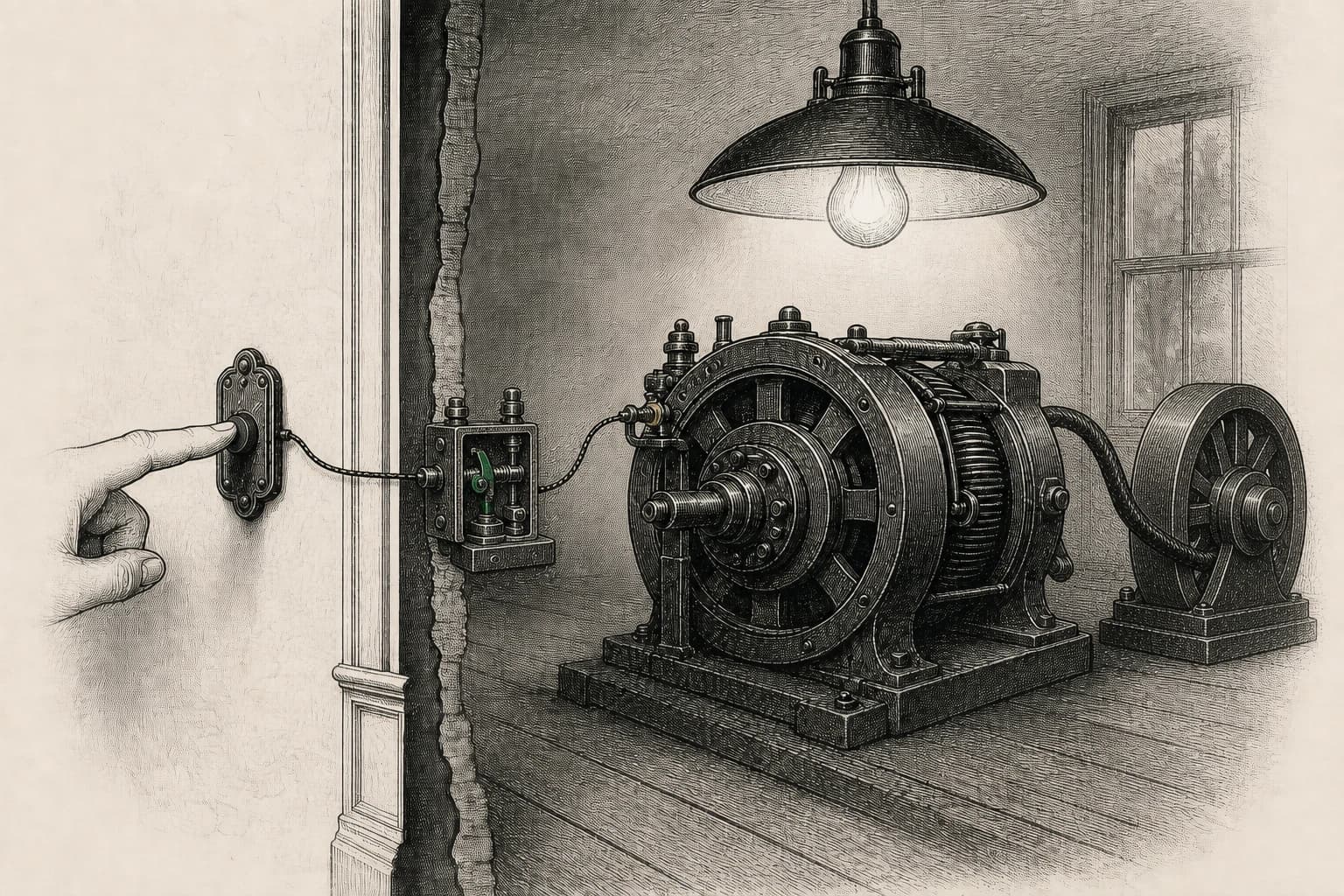
If a doorbell switches on a light, the bell does not manufacture electricity.
An emotional trigger works in a similar way. After the signal, a physical response, familiar emotion, thought and automatic action can appear quickly. I do not treat these as one compulsory sequence, nor use the signal as proof of the reaction's entire cause.
Someone hears a disapproving tone. The throat tightens. The thought *I am about to be humiliated* appears. Then they justify themselves or go silent.
It happens so quickly that everything looks like one fact: *They said that, therefore I am in danger.*
But the external event, the first response, the explanation and the action are four separate events.
When I work with a strong reaction, I slow down one episode:
- What did the person see or hear?
- What changed first?
- Which thought appeared?
- What did they do automatically?
The trigger stops being a mystical word for everything unpleasant. It becomes an observable point of entry.
Why a reasonable person can react “illogically”
An automatic response can begin before a calm assessment is available.
A knee reflex does not ask whether you consent to lifting your foot. An automatic emotional response can also start before conscious choice.
Afterwards, the person understands perfectly well that the salesperson may simply have been tired, the pause proves nothing, and today's manager is not their father. Yet the same tone starts the response next time.
Understanding has explained the present. It has not changed the automatic connection.
In my working model, today's signal may be connected with earlier episodes in which a similar tone, look or place accompanied a powerful response. Current stress can amplify the start.
That is a hypothesis to test—not a rule stating that every emotion is secretly from the past.
A strong reaction does not prove the present danger is imaginary
Sometimes the tone really is humiliating. Sometimes another person is applying pressure, making a threat or crossing a boundary.
So I do not begin by announcing, “It is only your trigger.”
First, I separate present facts:
- What did the other person actually say or do?
- Is there real danger?
- What action is needed today?
Then I examine what remains. Why does the response stay equally strong with another person, in another setting, or even when the signal is only imagined?
Removing older charge does not make bad behaviour invisible. Usually it becomes easier to name the behaviour accurately and choose a proportionate response without the automatic explosion.
One signal may not remain the only one
Other signals can begin producing a similar response when, for that person, they are connected with the first.
This is not a universal category or a compulsory ladder of expansion. The important distinction is simply that a neutral response to one signal tells us nothing conclusive about every similar situation.
Each signal that genuinely starts the response needs to be observed and tested.
What counts as a result?
Not being able to explain quickly, “This is a trigger.”
The main sign is simpler: the familiar signal no longer takes choice away before the person can assess the facts.
Real danger, useful caution and necessary boundaries remain. The change is that a brief signal no longer governs the entire response on behalf of the past.