The day has ended. The laptop is closed. The phone lies beside the bed looking entirely innocent.
The mind continues its shift.
First it replays one conversation, then a second event, then a third—and returns to the first. Nothing new is discovered, no decision arrives, but the day refuses to finish.
Or you fall asleep and wake around four. This time the mind does not review yesterday. It opens tomorrow’s list: write this, answer that, do not forget the other thing, and what happens if none of it is finished?
Both scenes involve lying awake and thinking. I do not assume they are the same process.
Sleep is a separate subject in my work
I do not place every kind of night-time thought in one box marked “anxiety.” I distinguish at least four possible lines:
replaying events from the finished day
≠
thinking about future tasks after waking
≠
tension that remains in the body
≠
stress accumulated over years
They may arrive together. That does not make them interchangeable.
If we fail to identify what is happening, we can begin fighting “sleep” in general. Sleep, meanwhile, has done nothing wrong.
Sometimes the mind has not finished the day
Before sleep, the mind may select a few events and repeat them in a loop. They need not be the most important events, and the order need not make much sense.
It can feel like analysis, but analysis moves towards a conclusion, decision, plan or action. Here, the material does not change.
One useful entry is a deliberate procedure for completing the day. Rather than allowing the mind to pick three episodes at random, you move through the day systematically from its final moment back towards the beginning.
This is not an invitation to invent a new biography at midnight or investigate the root cause of every conversation until sunrise. It is a way to review events in sequence and let the day acquire an ending.
That is different work from endlessly repeating event one, two and three.
At four in the morning, tomorrow may have started early
Bedtime and early waking can contain different unfinished loops.
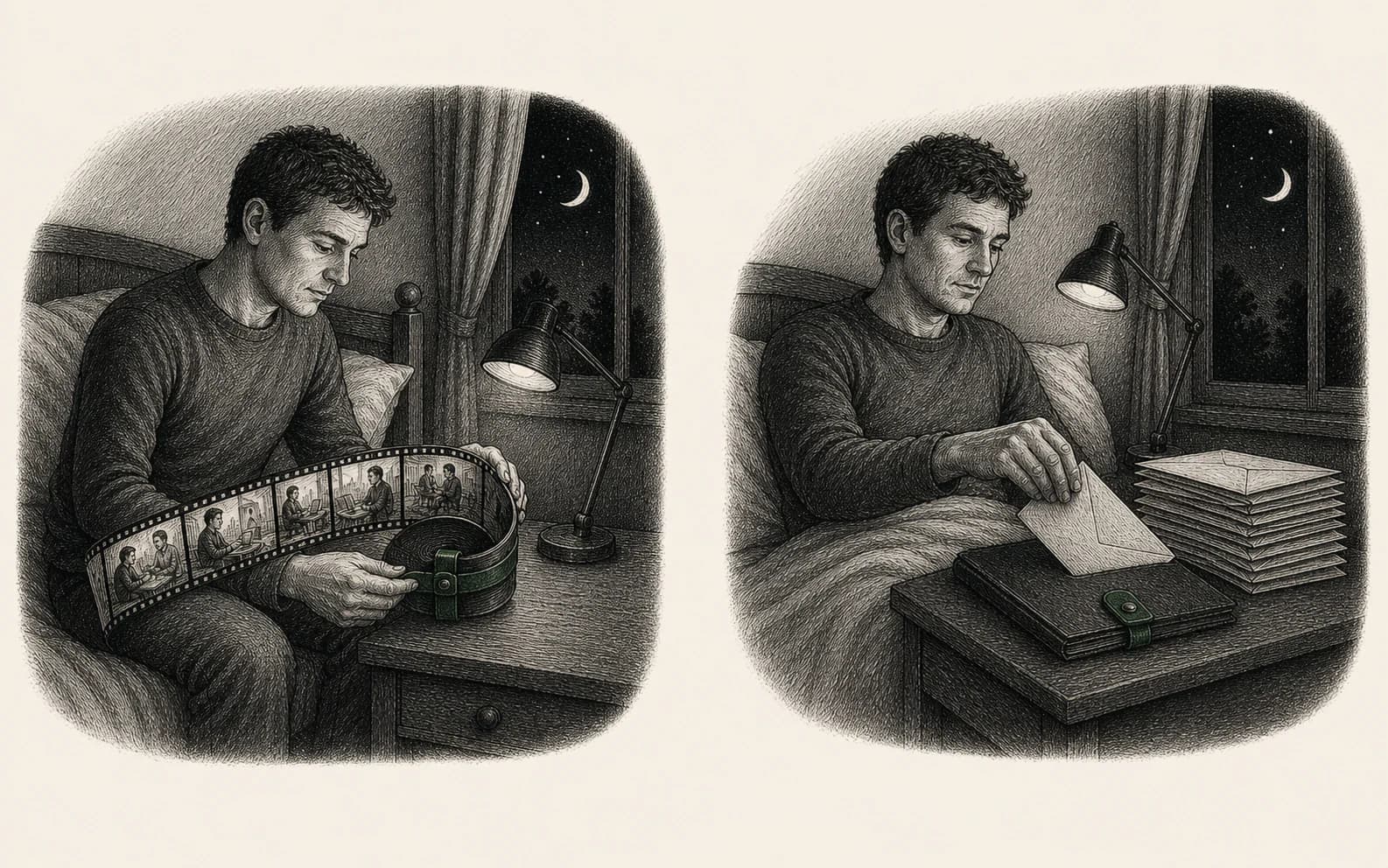
An early waking can have a different shape. The eyes open and the tasks appear immediately.
Internally, the person is already writing the email, having the conversation and solving a problem that cannot physically begin for another four hours. The bed has become an exceptionally poor office: no desk, no light, yet somehow plenty of work.
If the person is not thinking about yesterday, completing yesterday again misses the target. The active cycle is the response to tomorrow’s tasks.
The task itself may be real. The thought “I need to do this” may be useful. But performing it mentally for two hours without new information is not the same as doing it in the morning. The email remains unsent; only the person expected to send it has slept less.
Record the task if needed. Then work with the current response rather than pretending the night is productive planning time.
The thoughts may quieten while the body remains on duty
Some people are not conducting a long inner conversation. The speed remains in the body instead: raised shoulders, pressure in the chest, a sense that another demand is about to arrive.
The calendar has ended the day; the state has not.
Here, persuasion about the beauty of sleep may achieve little. The first step is to notice what remains active and reduce that present response. In my work I use a hands-based Off-Switch practice for current bodily stress. The closed instructions are not reproduced in an article, but the distinction matters: a body still holding the day requires a different entry from a mind replaying three events.
A hard week is not the same as accumulated strain
Today’s conversation may be only the latest layer on a background built over years. Work, family, money, news and ordinary life are not famous for checking whether there is room before adding more.
That is why I distinguish current thought, present bodily tension and the larger accumulated load. The latter needs regular work rather than one beautiful evening routine.
As a person becomes able to notice and reduce stress responses during the day, the overall background may fall. Sleep may improve as a consequence because less unfinished material arrives in bed.
I do not promise to command sleep
The tempting claim is simple: do the procedure and you must fall asleep.
You must not.
Not every waking is caused by work thoughts. Not every sleep difficulty is psychological. Four in the morning is a time, not a diagnosis. Physical, medical, environmental and behavioural factors may matter and deserve appropriate assessment.
This article describes patterns I can distinguish from the actual content of a response:
- replaying the day;
- starting tomorrow’s tasks internally;
- carrying present tension in the body;
- bringing a larger accumulated load into the night.
Working with those patterns is not treatment for insomnia and does not rule out other causes.
Better sleep is a consequence, not an order
The more often a person can notice and interrupt stress responses during the day, the less the night has to process the entire emotional warehouse after closing time.
Over time, falling asleep may become easier. Finished events may stop walking in circles. An early waking need not become the start of an unpaid shift. Bodily speed may fall.
I describe this carefully: sleep can improve as a by-product of reduced stress. I am not ordering sleep to behave. I am working with what keeps the system active.
The next ordinary nights provide the test
The useful test is not one perfect night after an encouraging session.
After an ordinary day, do the same three events return in the same order? Can you finish the day rather than repeat it?
If you wake early, does tomorrow’s list occupy the hours until the alarm, or can you record what matters, interrupt the response and return the work to morning?
What happens to the tension in the body? What changes as the larger stress background comes down?
I am not aiming for a head in which no thought ever appears. The task may be real and the day may genuinely have been difficult.
The question is whether the mind must keep turning the same material after it has stopped producing a solution.
When the day can end, tomorrow can wait until tomorrow and the body can leave daytime speed, the night becomes a night again—not a second shift nobody agreed to pay for.