Before the conversation, the person knows what to say. There are arguments, numbers and a reasonable request—perhaps even a written plan.
Then the manager appears on screen, looks a certain way and asks one short question.
The person becomes smaller.
Not physically, unfortunately. Shrinking to twenty centimetres and hiding behind a coffee cup until Zoom ends would at least be clear.
Internally, the position disappears. The voice softens. Yesterday's boundary becomes a cautious suggestion ready for immediate withdrawal.
The person says, “I am afraid of my boss.” Perhaps. But the current boss may not be where the story began.
A boss can be the source—or the button
Sometimes the response genuinely began with this manager: pressure, humiliation, punishment or threat.
Sometimes today's boss only presses a button installed earlier.
The chain may include a previous manager, teacher, coach, parent or another influential person around whom disagreement and error were unsafe.
The current manager may behave differently while the old response arrives intact.
New title, different person, same button.
A response recognises a signal, not a biography
Consciously, the person knows this is not their parent, teacher or former manager. Passport control has been completed.
The automatic response may not care about passports. It can recognise a title, tone, look, height, posture, phrase or the structure in which one person evaluates and the other must answer.
The similarity may not be logically obvious. Understanding that the boss is different does not stop the response arriving before choice.
This does not prove the manager is safe or good. It shows only that today's reaction may contain more than today's conversation.
Authority often stands higher internally
An ordinary manager may become enormous inside an old response.
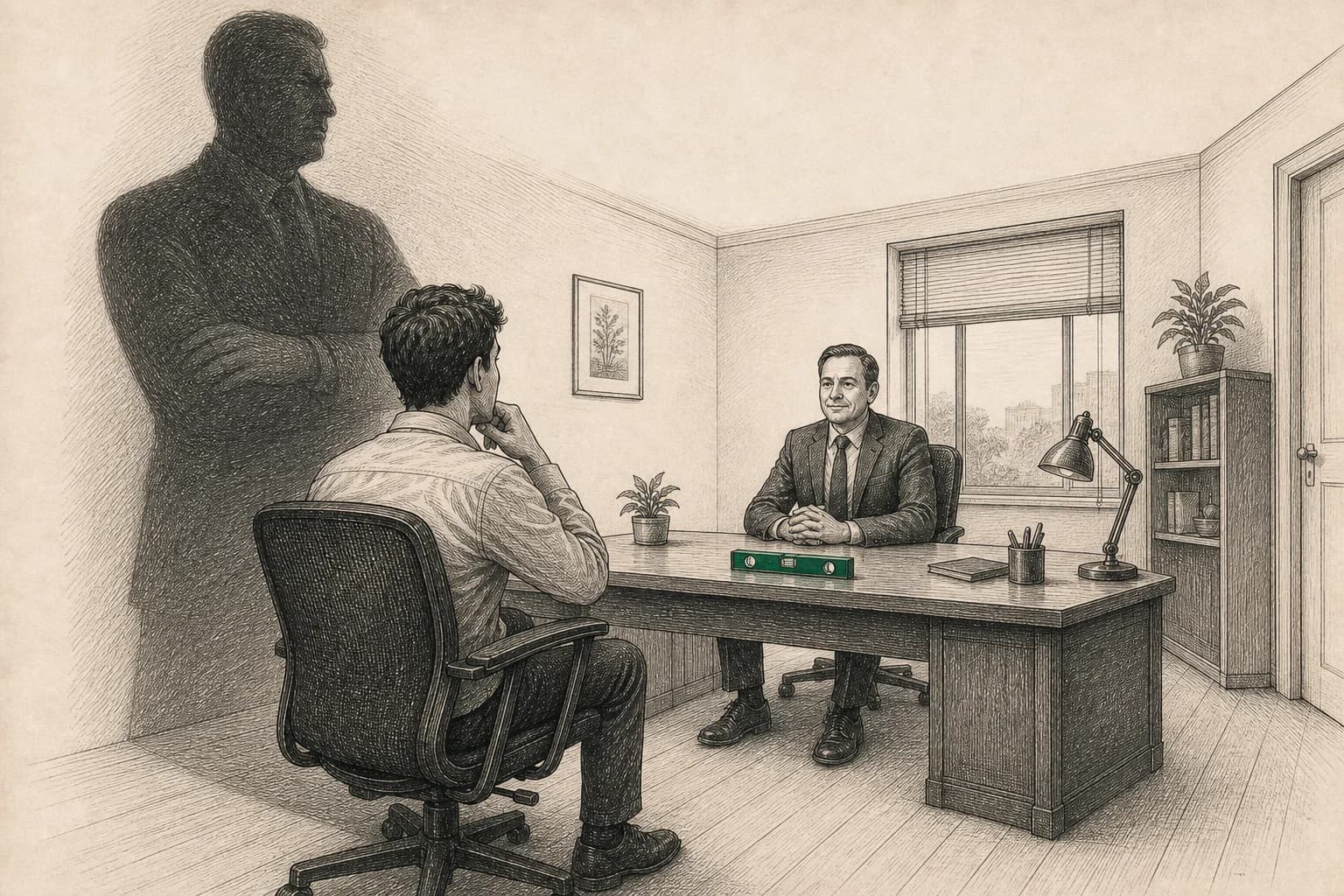
I ask how the person represents the manager in the mind.
Authority is often literally above; the person is below. For some, this arrangement connects with early adults, though I do not prescribe childhood as the cause before looking.
The person grew up. Their passport and salary confirm adulthood. The internal arrangement did not receive the update:
Authority above; I below.
Imagining the other person at the same level—or even slightly lower—can reduce freezing. It breaks a familiar arrangement.
This is a useful entry, not a universal solution to all managerial difficulty.
One boss may be only one scene in a wider type
Neutralising one unpleasant conversation does not necessarily change the response to every authority figure.
Other scenes may remain active: parent, teacher, coach, former manager—several situations in which the person occupied the same internal position.
I do not need to prove perfect historical connections. I need to find material that still starts the response, work with it and test the current figure again.
Moving the image is not the same as completing the past
Changing the internal height may give quick access to the person's voice.
Then I test more honestly: what happens with the usual image, voice, look and imagined conversation?
If the old response returns, the image gave a useful entry without completing the target.
The aim is not to move the manager around the internal screen like furniture before every meeting. It is for the old arrangement to stop governing the state.
I show the current manager again after the work
The test is the same figure and a normal difficult conversation—not a fantasy in which the manager apologises and brings flowers.
Can the old fear or shrinking be produced? Is the person's position still available? Can they say what they intended?
Then the test moves into life. The manager's agreement is not under our control. The question is whether the person could act without automatically becoming small.
After fear, a skill may still be missing
Less fear does not teach a request, feedback, a deadline discussion or no.
If there is no plan, that is not necessarily hidden trauma. The person may need communication skill: what to say, which decision to propose, where the boundary lies and what to do after different answers.
An old response and a missing skill can look the same from outside—the person said nothing—while requiring different work.
Sometimes the boss is genuinely the problem
A manager may genuinely humiliate, apply pressure, break agreements or demand the impossible.
Removing old fear does not transform that person into a good leader or oblige anyone to love the system.
The real problem may become clearer: speak, document, escalate, change role or leave.
Continuing to work on oneself because the manager continues behaving badly is an unusual development strategy.
The result is that today's person becomes today's person again
First, remove what previous authority figures add to today's scene. Then look again at the current manager.
Perhaps the boss only pressed an old button. Perhaps the response changed but the conversation still needs learning. Perhaps the boss truly is the problem.
Now the present person is responsible for the present situation—not an entire historical committee speaking through one voice.