Before the conversation, the person knows: *I do not want to do this.*
Then someone asks. They smile, soften their voice and say, “Yes, of course.”
The conversation ends. Only then does the sensible answer return:
Why on earth did I agree again?
Sometimes they keep the promise and feel angry. Sometimes they delay, do it badly or avoid the second conversation altogether. The no existed internally from the beginning. Somehow it never reached the voice.
My main question is not why the person does not know what they want. They do know. The question is what acts before their decision.
The no was present, but the response was faster
Fear of conflict, punishment, rejection or another person's displeased face can start before choice.
The body has already selected safety: agree, do not argue, do not upset them.
Consciously, the person can decide that next time will be different. This resembles deciding solemnly not to move your leg before a neurologist taps the knee. The leg remains unimpressed by the resolution.
A well-learned automatic response does not ask whether the old answer fits today's circumstances.
Once, disagreement may genuinely have been unsafe
This response often develops where a child could not argue with an important adult. The adult was larger, stronger and decided what was permitted. Agreement reduced conflict or punishment.
At the time, it may have been the best available option.
The child grows up. The person opposite is now a manager, partner, client or simply someone wearing a displeased expression. Yet the old programme can act as though the conditions never changed.
The same response can be learned later beside an aggressive partner, where every no produced pressure, conflict or punitive silence.
I do not assign one compulsory cause. For one person it is conflict, for another abandonment, for another punishment. Sometimes one tone, expression or word starts the response. Logic may be in limited supply; the response is no weaker for it.
Automatic agreement is not compromise
The word *yes* proves very little by itself.
A skilful communicator can say, “Yes, I understand why you need it. I cannot do it today.” They have acknowledged the other person's need while keeping their position.
In a conscious compromise, someone can agree, refuse, offer another time or propose another solution. They understand the choice and then act accordingly.
With automatic agreement, there is no choice in the moment. The person cannot say no, so says yes and remains internally opposed.
I am not examining one word. I am examining whether choice was available.
A compulsory yes often produces quiet sabotage
Automatic agreement is difficult for both people.
The other person heard a promise and expects it to be kept. But no real decision was made internally. Anger, resistance and the sense of being forced remain.
So the person delays, forgets, performs badly or does nothing. They could not set a boundary with words and try to set it later through behaviour.
It is an unfortunate system: an honest no feels dangerous, so they give a safe yes—then create a much larger conflict by breaking the promise.
This is not necessarily deliberate manipulation. Often it is the continuation of being unable to defend a position directly.
A smile can mean “I surrender”
Agreement may happen before free choice.
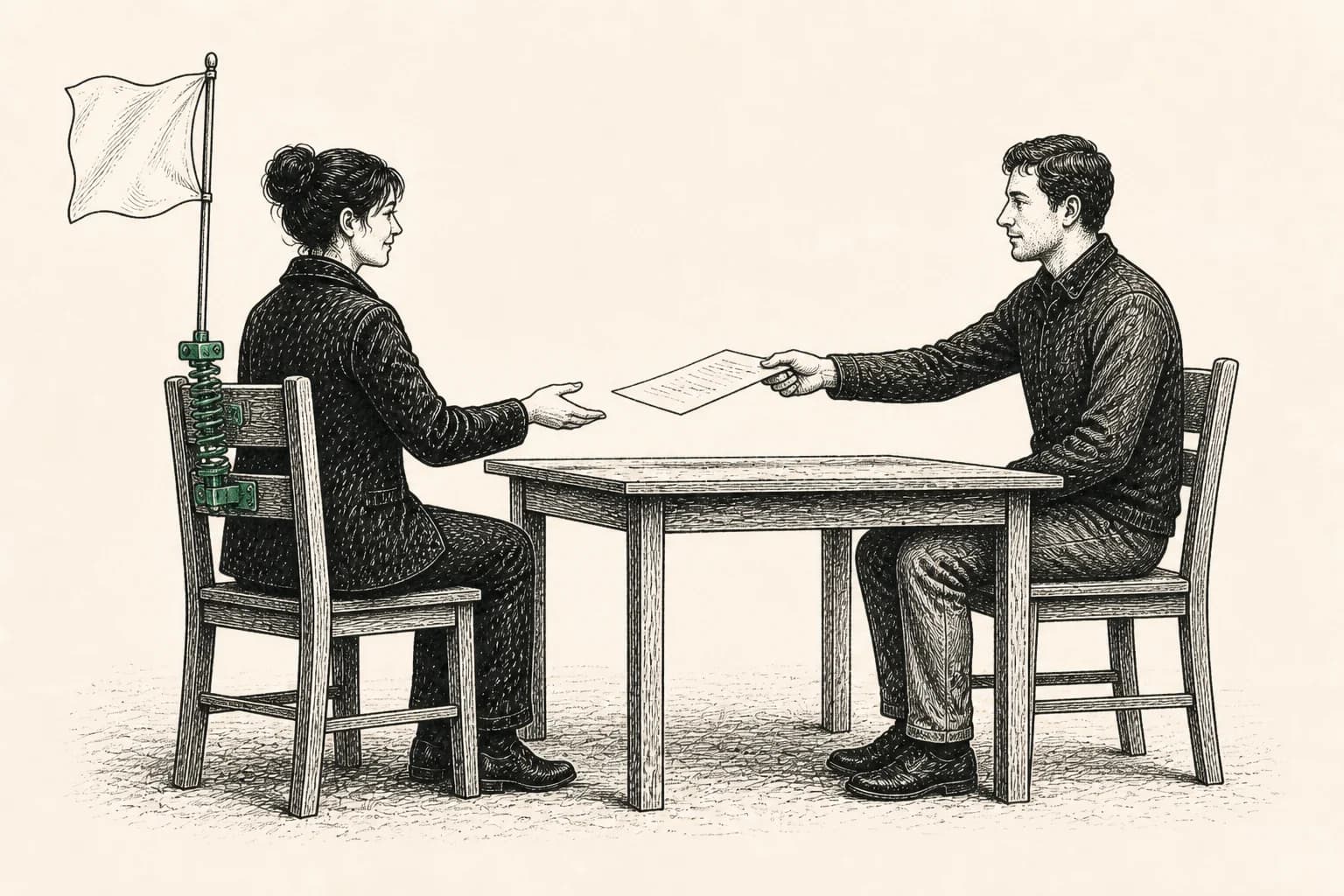
A smile is not always joy. Sometimes it is raised hands.
The person sees a displeased face, hears a hard voice and smiles automatically, becomes softer and tries to be liked: *I am good. I am not dangerous. Please do not attack me.*
The answer is not to learn a permanent stone expression. Free friendliness means being able to smile—or calmly not smile.
An automatic smile driven by fear occurs before the person chooses how to conduct the conversation. It puts soothing the other person first and considering oneself somewhere in the next administrative quarter.
Deciding to say no next time is not enough
Someone can learn ten elegant boundary phrases and keep one on a card. If another person's displeasure starts the old response in the real conversation, the card does not govern the body.
I therefore begin not with the perfect refusal but with what makes the refusal unavailable.
We identify situations maintaining automatic agreement and work with their emotional charge. There may be one early scene or a chain of later moments in which the person kept agreeing against themselves.
Then we test: imagine the person who was impossible to refuse, their request, face, voice and possible displeasure. Does the body tighten? Does the voice disappear? Is there an immediate need to agree?
If so, more remains active.
A new conversation still needs to be learned
Removing an automatic response is not the same as learning a difficult conversation.
Someone may no longer fear the manager but not know how to discuss a deadline. They may disagree with a partner but not know how to state a boundary without a ten-minute defence speech.
The old response can leave without installing a new communication skill by magic.
So we build the action separately: the words, tone, alternative proposal and response if pressure continues.
Sometimes the answer is simply, “No, I will not do that.” Sometimes it is, “I cannot today; I can on Thursday.” Sometimes the chosen answer is genuinely yes.
The difference is that it belongs to the person rather than to automatic surrender.
The future conversation is tested first
Before the real situation, the person imagines the conversation, hears the request and gives the new answer.
If fear, guilt or the urge to smooth everything immediately returns, we have useful information: another response to address or a skill to practise.
When the imagined conversation is manageable, the action is repeated, then tested in life. A boundary existing only in imagination is still awaiting installation.
How I work with the automatic yes
I do not begin with twenty assertive phrases. I begin with one request to which the person wanted to say no, but heard their own ‘yes, of course’ before they had decided.
They picture the other person’s face, voice and possible displeasure. We locate the smile, softened voice, guilt, fear of conflict or urgent need to smooth everything over. That is the present response we first need to make manageable.
Then we work with the scenes that actually appear beside it: a parent, punishment by silence, an aggressive partner or an authority around whom being convenient once made sense. I do not assign everyone the same childhood in the interests of administrative efficiency.
I remove the white flag, not the smile.
After the response, the person still needs an answer
When automatic surrender is gone, we build the skill separately: a short no, another deadline, a compromise or a deliberate yes. The Method does not write the boundary or make the decision for them.
The real test is the next request. The person does not have to refuse everything. They need enough time to hear themselves, choose and tolerate the other person’s response without automatic capitulation.
The result is not saying no to everyone
Turning a habitually agreeable person into someone who refuses every request would merely replace one automatic response with another.
The result is choice: agree when you genuinely want to, refuse without panic and endless justification, offer a compromise, tolerate someone else's displeasure, and then act consistently with your answer.
First, the person stops surrendering automatically. Then their own voice becomes available. Real life establishes whether they can use it.