There is an apparent contradiction in my process.
I say there is little point building new responses on top of an old structure that is still collapsing. Then I say that, at roughly 70% of the first clearing list, a person can begin constructing new patterns in parallel.
So which is it? Remove every last brick before beginning anything new, or clear with one hand while building with the other?
The answer is that construction can begin before every part of the clearing is complete. That does not mean abandoning the old work at 70% and opening the building with a ribbon-cutting ceremony.
Two opposite extremes create the same delay
At one extreme, construction begins too early. The person remains completely governed by fear of the manager, automatic agreement or the inability to stop when exhausted, while trying to place attractive boundaries and a confident new identity on top.
This produces a new sign on the old door. The person uses the correct language and repeats the same action when the situation arrives because the load-bearing structure is unchanged.
The other extreme looks more orderly: “First I must resolve absolutely everything. Then I will live.”
Years can pass while somebody waits for a biography with no unpleasant episode, odd thought or bodily sensation remaining. This day is wonderfully convenient to wait for because it stays safely in the future.
The old may already govern very little, yet construction remains postponed until mythical perfect readiness.
Seventy per cent is not a laboratory result
My working marker is roughly 70% of the first list. “Roughly” is doing important work here.
This is not a medical norm, a universal threshold or a test after which a computer prints permission to begin a new life.
It describes a practical stage. The first broad pass is well advanced. Much of the important material on the surface has changed. The person can manage current responses independently. Different triggers no longer combine into one daily catastrophe. There is enough room not only to interrupt the old, but to test something new.
If the point arrives slightly earlier for one person and later for another, I will not argue with a living human for the sake of a satisfying percentage.
The test is whether the old system has stopped occupying the whole site.
Beginning construction does not end clearing
Removing the old and building the new are different jobs that can overlap.
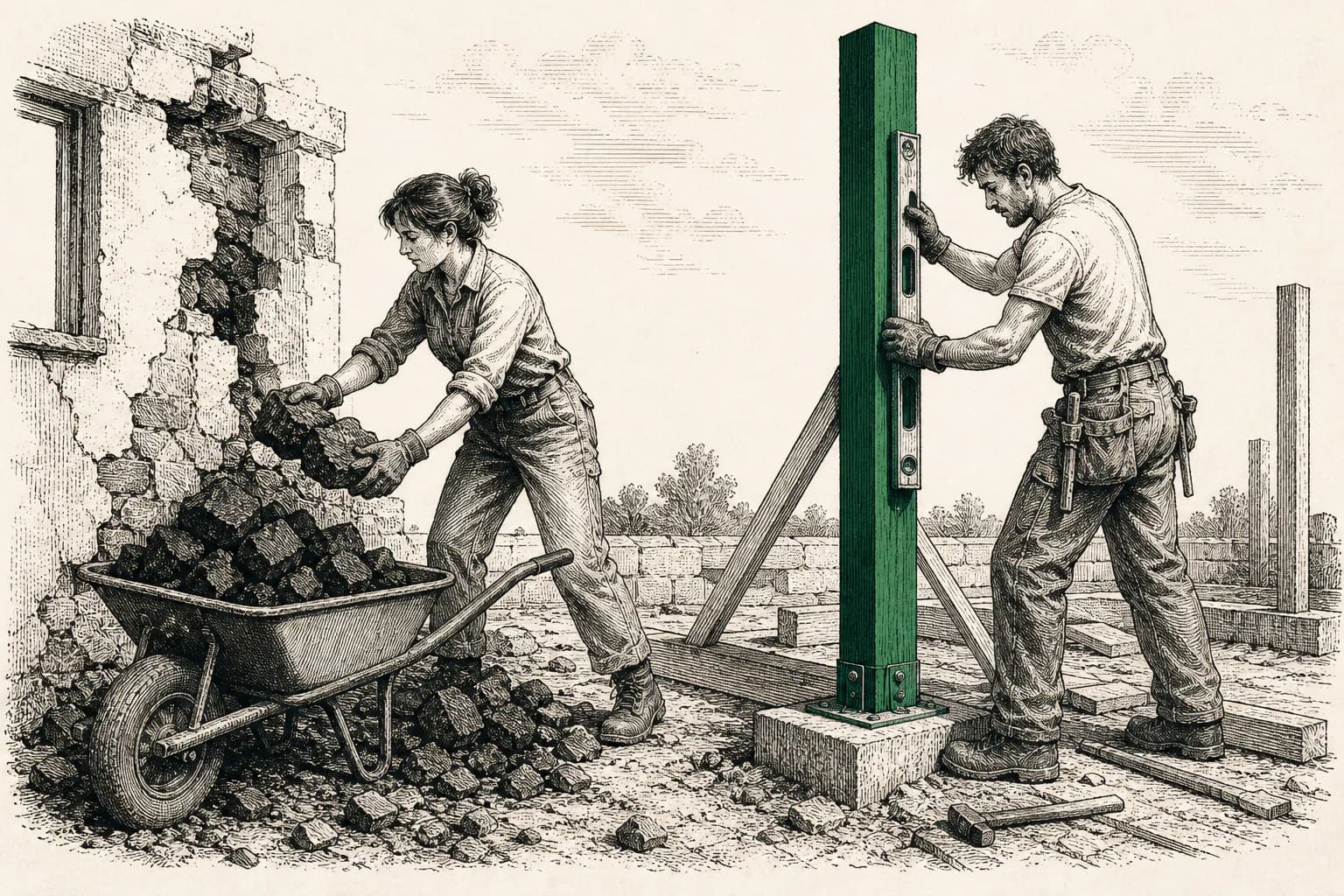
For a time, two processes run together:
continue completing the first clearing list
+
begin building and testing new actions
Not instead. Together.
Beginning to say no in accessible situations does not mean every old response around boundaries is complete. Reorganising a week does not guarantee that guilt about rest will never return. Choosing a direction does not turn every previous experience into irrelevant paperwork.
New actions bring real life into the process, and real life quickly reveals where the old response has genuinely changed and where something remains.
Parallel work makes the test more precise.
The first list still needs an ending
Seventy per cent is a point for beginning parallel construction, not escaping the clearing stage.
The defined first pass should be completed. Otherwise, it is easy to choose the most comfortable 70%, enjoy the relief and leave untouched precisely what is hardest to approach.
That is not a transition to the future. It is well-organised avoidance with an excellent project name.
I do not require endless excavation for new trauma. But the route already identified as the first pass needs to reach its planned end, so construction rests on a substantially changed background rather than one unusually good week.
The second pass is polishing, not a new mine
After the broad route through periods, people and events, I use a more detailed second pass. I call it polishing.
Not a new quarry. Not another life devoted to finding what is wrong. Polishing.
At that stage, individual emotions, beliefs, bodily responses and future fears can be checked more precisely because the general noise is lower.
First the bulldozer, then the scalpel. The person need not remain on an empty site until the scalpel has ceremonially completed everything in existence.
Construction tests the foundation
Suppose the person decides to set a new boundary at work. It seems manageable in imagination.
Then the real conversation happens.
If they decline calmly and can tolerate the response, the new action is available. If they agree at the last moment, the earlier work need not be declared useless. We investigate: did an old response return, did a specific fear of punishment appear, were words missing, or did the manager impose a real condition that must be addressed as external reality?
Construction creates the future and tests the foundation. Without action, a remaining weakness can stay invisible for a long time.
Not everything new must begin on Monday
Beginning construction does not require launching a new job, relationship, identity, calendar and personality in one week.
Build what is available and genuinely needed: one conversation, rule, skill or action that was previously blocked.
The order belongs to the person’s actual life. I do not distribute a standard catalogue of the correct future.
The purpose is not to fill every available space urgently. It is to stop living only in demolition mode and begin creating the life for which the clearing mattered.
The result is not perfect emptiness
I do not wait for somebody to become an entirely cleared human and then enter the future in a small ceremony. Life keeps happening throughout the programme.
My test is practical: old responses no longer govern the main areas of life; the person can handle what still appears; the first list continues towards completion; concrete new actions begin; reality tests them; a later pass polishes what remains.
The person is not adding a floor to a house that is falling down. They are also not living on an empty site for ten years while searching for the final historic brick.
At some point, little enough of the old house remains for the new one to begin.
Clearing the past and building the future can then proceed alongside each other—each helping to test the other.