A dissertation needs writing.
The person sits down, notices a mug that should be removed, then discovers the desk behind the mug and the entire room behind the desk.
Several hours later, the home has never been cleaner.
The dissertation remains theoretical.
The person has not forgotten it. They know the deadline is approaching and delay will make everything worse.
I am less interested in the label *procrastinator* than in the moment before the first step. What do they picture when they are about to open the document? What do they feel before beginning?
Sometimes the whole structure is already there.
Understanding consequences does not necessarily start action
Someone may understand the consequences perfectly—and criticise themselves in such detail that it becomes a separate assignment due on Friday.
Knowing that tomorrow will be worse does not make the first step available today.
This is not necessarily a problem of intelligence or a deliberate plan to damage life. The person may sincerely want to begin and still not approach the task.
The unpleasant process has already been imagined
The task appears together with several difficult parts: too large, too hard, possible error, unclear beginning, long concentration, evidence of inadequacy.
The person has not opened the document, but has already pictured the most unpleasant version of the process. Fear, uncertainty and tension join the image.
They attempt the first step from that state.
I do not claim all delay works this way. A task may be unnecessary, time absent or the method unknown. But when a strong unpleasant picture sits beside one first step, I work with that specific response rather than with procrastination as an identity.
Substitute work can look entirely reasonable
Useful small tasks can form an immaculate detour around the important one.
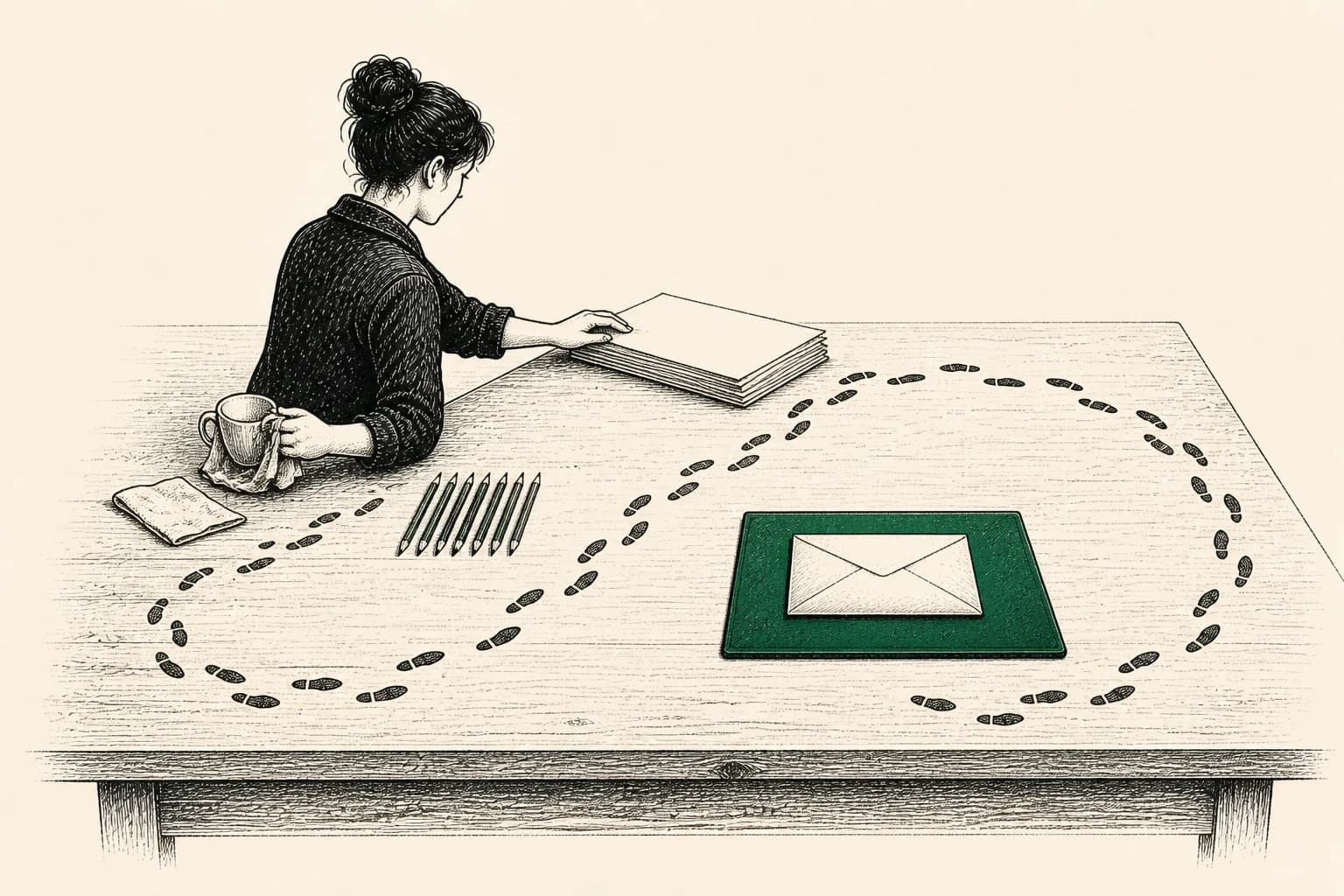
Avoidance is not always lying on a sofa.
The person cleans, answers email, files documents, rewrites the list or finally organizes a folder untouched for six months.
Each activity is useful, which allows the day to be defended persuasively. The difficulty is that none approaches the principal task.
I do not call every cleaning session sabotage. A conscious change of priority is normal. The question is whether the person can return to the first step—or automatically circles away again.
At the last moment, the task is not easier
As the deadline approaches, the unpleasant response remains. Another fear becomes stronger: *I will not finish.*
One unpleasant response finally exceeds the other and action begins.
The document did not become shorter or easier. The person simply works through the night under external force, then promises to begin earlier next time.
Next time, the same image waits beside the first step.
Delivering under deadline pressure does not mean the pattern is solved. The deadline is repeatedly hired as emergency motivation.
“Pull yourself together” does not change the image
Plans, reminders and discipline can help. But another calendar entry does not remove fear, uncertainty or an imagined failed future attached to the first action.
Motivational speeches may also lose to a large internal picture of the unpleasant process that begins now.
I first identify what makes the first step unavailable.
I test one first step—not “procrastination”
The label is too large to test. Delaying a dissertation, call and report may have different causes.
Choose the task. What exactly is step one: open the document, write the heading, make the call, request the data?
The person imagines that moment. What appears? What feels difficult or risky? How strong is the response from zero to five?
We work with the accessible element and return to the same first step. If the response remains, perhaps the active part is not the work itself but error, judgement or a later conversation.
I do not need a grand theory of the person's procrastination. I need a specific element and a test.
After the response changes, build another future
Less tension does not write the dissertation.
I use the opposite strategy: imagine the completed work two weeks from now, feel the state after completion, then look from there at the first accessible step.
This is not manifestation; the dissertation will not materialise beside the newly clean kitchen.
The sequence is practical:
remove the response blocking the start
→ create a concrete picture of completion
→ name the accessible first step
→ do it
The task may remain difficult. It simply no longer begins inside a bad future produced in advance.
Conscious rescheduling is not automatic delay
Some tasks should be moved: higher priorities exist, data is missing, another person is needed.
With conscious rescheduling, the person knows why, chooses a new time and names the next step. There is a decision rather than an abstract promise of later.
The useful question is whether the action was actually rescheduled—or remained inaccessible.
How I work with the response before the first step
I reduce the target from ‘procrastination’ to the first observable moment: opening the document, making the call, sending the first line or entering the room. We identify what has already been imagined around that step—failure, criticism, boredom, exposure or endless effort.
Once the response attached to the first step changes, we build a different future in practical terms: the smallest action, the time and the conditions. A calmer nervous system is useful, but it does not possess a project plan by divine intervention.
The test is gloriously unromantic: did the person begin?
If the response is gone but the skill, structure, information or chosen goal is missing, the work changes category. We build what is absent instead of continuing to hunt for fear because fear used to live there.
The result is that the person began
Understanding the delay is not the result. Calm beside the task is an intermediate test. The finished image is a strategy.
The result is opening the document, writing the paragraph, making the call or sending the request.
One first step proves only this particular stop changed. The next real situation tests the wider pattern.
If the person is calm but still does not begin, the next question is no longer necessarily fear. It may be the plan, skill, time, structure or conditions.