The dangerous event is over.
The person is no longer there. It may be quiet around them. Nobody is attacking, shooting or threatening them now.
But inside, the rehearsal continues:
- What if it happens again?
- What will I do then?
- What if I cannot cope next time?
From my perspective, the brain has become stuck rehearsing what to do if the event were to repeat again and again.
The event ended. The rehearsal did not.
The brain keeps asking, “What if it happened again?”
I do not use this phrase as a clinical definition of PTSD. It is a working metaphor for what I observe in a person's response.
There was a situation the brain registered as traumatic and life-threatening. The person may genuinely have been in mortal danger, or may have experienced the event that way even when the external facts were different.
The situation passed, but the memory remains active.
It can return as an image, a sound, a physical response, a flash of aggression or an urgent feeling that something must be done when nothing is happening now.
Each time, the same internal question begins again:
What if it happened again?
The system is not writing a new plan. It is rehearsing an old danger.
Current danger and an old rehearsal are not the same
The danger has ended while an old recording rehearses its return.
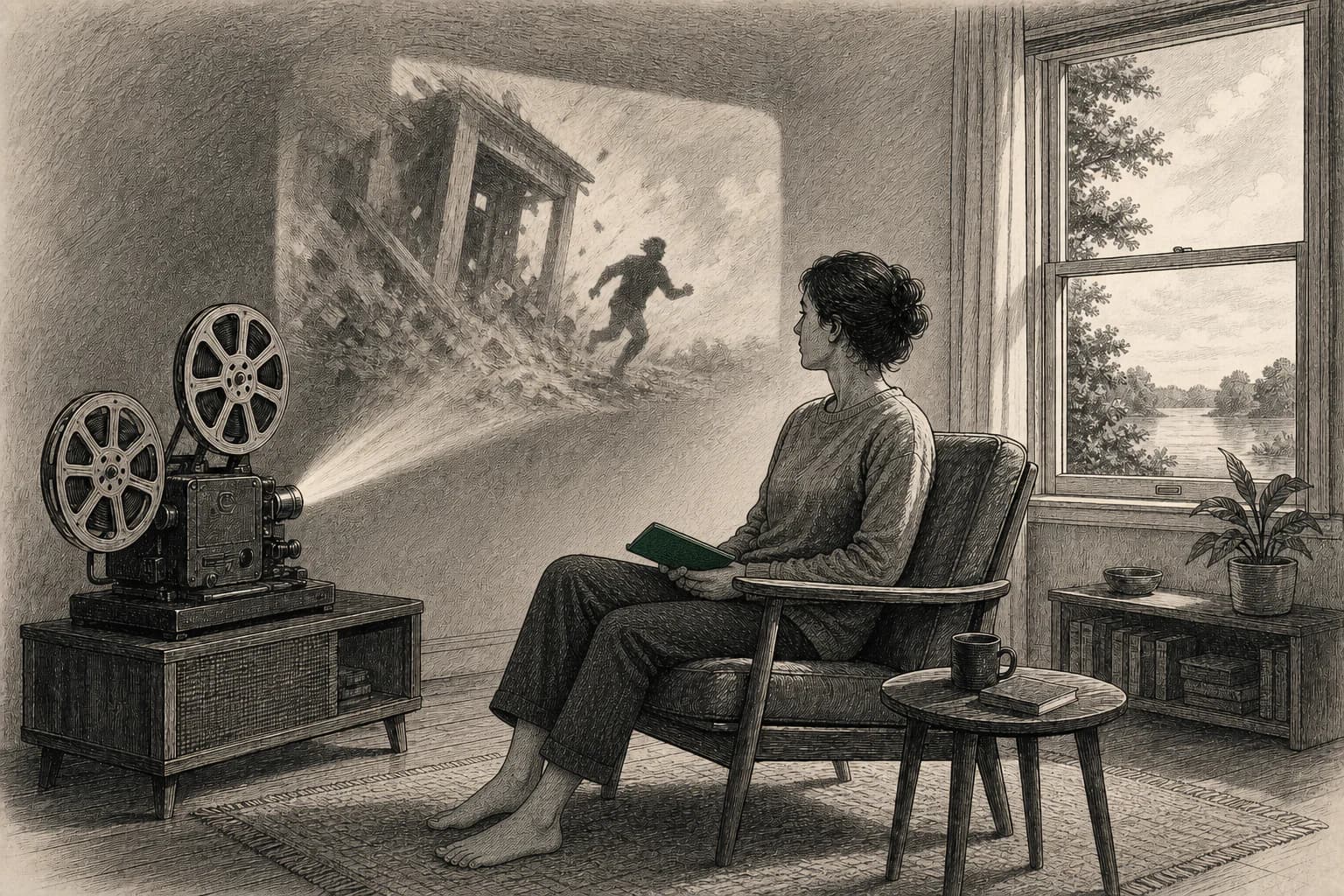
This boundary cannot be skipped.
If danger is continuing now, the person does not need an elegant conversation about an internal response. They need practical action for safety.
A technique cannot stop a war. Inner work cannot make an attacker safe. An ongoing threat cannot be reclassified as a memory because that would make the professional model more convenient.
This article concerns a different situation: the event has ended, while the system continues responding as though it remains nearby.
Then I look beyond the content of the story to what is still starting now.
One severe episode can occupy nearly the whole screen
Sometimes one event dominates.
The person returns to one scene, hears the same sounds and feels the same response. The whole system appears to revolve around a single recording.
Even then, I do not immediately declare that I have found the one perfect cause of the person's entire life.
There may have been an earlier background. Later episodes may have developed: fear of the response itself, inability to sleep, an outburst towards someone close, avoidance of a place. Each can acquire its own charge.
One loud scene and the entire pattern are not necessarily identical. We can complete the response to one memory and then check what remains nearby.
Layered memories require precision, not an axe
The most complex situation is one in which many difficult memories overlap.
There may be one episode, then another, then a third—or months and years in which danger was not a single scene with a clean beginning and end.
Someone may say one word—*war, crash, violence*—but the word stands for a sequence rather than one recording.
I call this precision work.
Not because the problem should be admired under a magnifying glass for ten years, but because all the material cannot be thrown into one pile and processed in one heroic attempt.
We need to distinguish episodes and reactions, identify what is accessible now, check the person's state and avoid confusing speed with pressure.
With multiple severe memories, I work in private 1:1.
A new event can wake what was already present
During a large-scale project with people affected by the full-scale war in Ukraine, I saw another configuration.
A wartime episode could create new difficult material. It could also activate responses that began much earlier.
Before the war, someone may already have had panic, old fears or difficult family and work histories. They had found a way to live with that background. Then a new event arrived and the entire system fired more intensely.
This does not mean the war created nothing and everything was secretly childhood. Nor does it mean every response should be attributed only to the latest event.
There can be an earlier background, a new impact and several layers at once. Calling all of it *one trauma* makes the work simpler only on paper.
Difficult material requires preparation
I do not begin with the worst scene merely because it is the worst.
First, the person learns to manage the present response: notice that it has begun, stop it and return to a more manageable state.
My formula is simple: when the reaction starts, use the hands.
At this stage, the old pattern may still return. But the person no longer has to fall helplessly into it every time.
Once they can work not only with one mild reaction but with several things firing in parallel, we can approach more difficult memories gradually.
Preparation is not a ceremonial wait for the perfect day. It prevents the difficult material from governing the entire process.
The work is with what starts—not with the label
I cannot place the word *PTSD* on a table and neutralise the word.
I can work with a specific memory, image, sound, physical response, expectation of recurrence or another episode that is accessible and testable now.
The general principle resembles the rest of my work: stop the automatic response, then gradually neutralise what supports it.
Resembles does not mean equally fast or simple. One accessible episode requires one kind of work; many layered severe memories require a different level of precision, pace and support.
The label may be the same. The material underneath can be entirely different.
Measuring symptoms is not diagnosing
In the war project, we measured manifestations described as PTSD symptoms. We did not diagnose participants with PTSD.
That distinction matters.
You can ask someone how strong a particular reaction is, measure it again later and observe that it became weaker or stopped starting.
That does not turn an authorial questionnaire into a medical diagnostic instrument. Changes in a large group do not prove a single cause of PTSD or establish that one technique is superior to every alternative.
I can state honestly what we measured, explain my working model and describe what I observe. The result does not improve when dressed in somebody else's uniform.
Completing one response does not complete every layer
Suppose a person works with one memory. The reaction begins strongly, then reduces to zero. They deliberately test it again and the old state does not appear.
That is a result for this target.
If the same label contains ten other episodes, the first zero does not have to turn the entire cluster into zero. We check neighbouring scenes, the imagined future, real life and the response to similar sounds, places or conversations.
Another layer may appear. That does not necessarily mean the first result “came back.” Material previously obscured by the loudest episode may now be visible.
This is why multiple events require precision—not a victory report after the first successful test.
The result is a present that becomes present again
I do not count a calm discussion of the story during an online meeting as the whole result.
I look at what happens when the episode is recalled again. Can the old reaction be produced? Does the system keep rehearsing recurrence? What happens in a similar real situation? Are there other scenes that still start the state?
The fact of the event does not disappear. The memory does not have to disappear. The ability to notice real danger should remain.
What can leave is the requirement to live inside an endless rehearsal of an event that has ended.
Then the past remains the past—not because it was forgotten, but because today's quiet no longer has to spend every minute preparing for yesterday's danger.