While the relationship was only a possibility, everything was fine.
There were messages, meetings and thoughts about the person. Closeness and mutuality were wanted.
Then the other person chose too. They came closer. Mutuality became real.
And precisely then, joy was replaced by coldness, faults and an urge to step away.
Yesterday they were interesting. Today they speak incorrectly, eat strangely, write too often or fail to remain silent in the approved manner. Nothing terrible has happened. The person nearby is the same. Yet distance suddenly feels necessary.
The quick conclusion is, “Then I simply do not love them.”
Perhaps not. Relationships are not the compulsory answer to every question. But first I would test whether this is a free decision—or whether an old response decided earlier.
The other person came closer—and retreat became urgent
Retreat can start at the threshold of safe closeness.
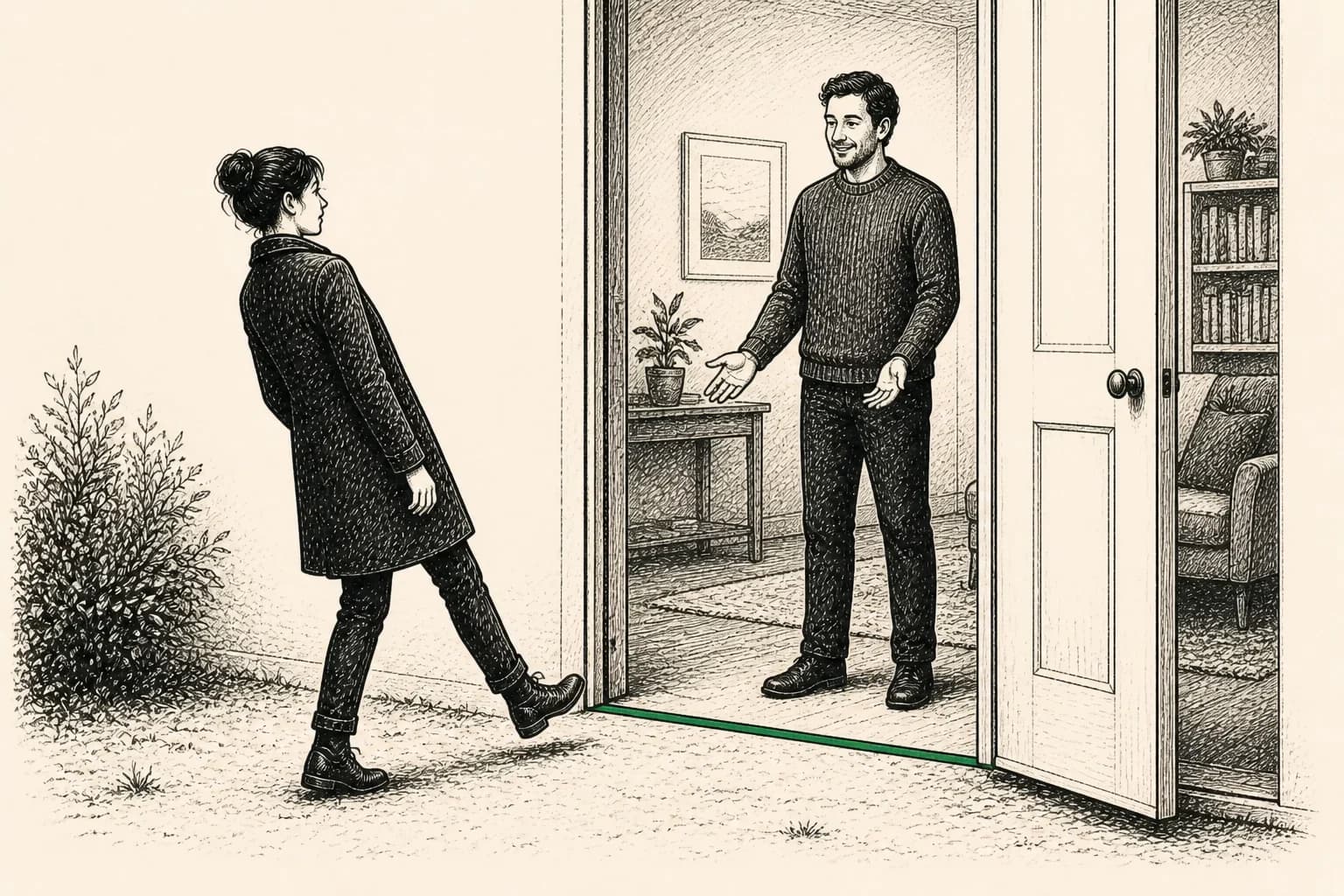
Relationships can produce two opposite patterns.
When someone withdraws or does not answer, anxiety can begin. That is one pattern.
In another, the person comes closer. The relationship becomes more serious and mutual—and closeness itself starts the response.
It may not look like fear. Someone rarely announces, “Your love frightens me.” They may become cold, see only flaws, lose desire, create conflict or make the other person retreat.
The behaviours vary. The signal is that the relationship has crossed from fantasy into reality.
Wanting a relationship and tolerating closeness are different
Someone can sincerely want a relationship. They are not pretending when they seek a partner or enjoy the meetings.
Conscious intention, however, is not the only participant.
When closeness becomes real, older responses can become stronger than the intention. One part wants to remain near; an automatic response is already directing a retreat.
This proves neither love nor its absence. It shows that before a major decision, today's person should be separated from the expectation of old pain.
Earlier pain enters today's contact
If closeness once ended in betrayal, rejection or another painful history, the system may remember not only the ending but the beginning of the sequence:
someone comes closer
→ I become vulnerable
→ they leave
→ it will hurt
The new partner has done none of this. Yet their approach starts anticipation of the former ending.
Avoiding that pain again becomes more urgent than remaining with the person.
I do not assume one betrayal behind every fear of intimacy. I ask specifically: what appears as the other person approaches? Which response, expectation and scene make the step backwards necessary now?
A painful future becomes more convincing than the real person
The past is only one part. The package includes a future the person has not lived but has already rendered in excellent detail.
There is rejection, the conversation, faces and exact words. They have already been betrayed or left internally.
In reality, someone has merely come closer. Inside, the feared ending is underway.
Distance then looks logical. Become cold first. Find a reason. Damage the contact. Do not let the relationship reach the point where the script says pain will occur.
The person is defending against a future already experienced as truth.
Cooling off does not prove a free decision
Noticing faults may mean someone is finally seeing real incompatibility—or that faults provide a convenient way to restore distance.
Desire may genuinely disappear—or the response may switch it off where closeness means danger.
A conflict may reveal a real problem—or create the distance the person could not request directly.
The same action can have a different structure. I do not diagnose fear of intimacy from one retreat. That would be fortune-telling with more furniture.
We take a specific scene, person and moment when coldness or the urge to leave began, then test the particular response.
Sometimes leaving first prevents being left
Fear of abandonment can produce clinging and control—or departure.
The second logic is simple: if I end it now, they cannot leave me later. At least the decision feels like mine.
Free departure and automatic flight can look identical externally. The question is whether choice existed.
If the person can remain in contact, examine the facts and still choose to leave, that is one result. If closeness makes distance the only available action, it is another.
I do not prescribe the correct relationship decision
Removing automatic withdrawal does not oblige someone to stay.
The relationship may genuinely be unsuitable. The other person may cross boundaries, be controlling or simply be wrong for them. Interest can disappear. Space can be a chosen need rather than flight.
My task is not to make someone love correctly. It is to remove what prevents them seeing the current situation.
Then they can ask: Who is in front of me? What is happening? What do I want? Which options exist?
The result may be continued closeness, a conversation, more space, a boundary or departure. Calm restores choice; it does not provide the answer in advance.
I test a specific scene, not the entire capacity to love
“I fear intimacy” is too broad to serve as one object.
We take a concrete moment when mutuality became undeniable and the relationship felt real. What happened in the body, desire, voice and decision? Which earlier pain and imagined future appeared?
The response is tested. The future is tested separately. Then the person looks again at the actual relationship.
Life provides the final evidence: what happens when closeness becomes real again?
How I work with the response to real closeness
I do not work with ‘intimacy’ as an abstract virtue. We choose one moment when closeness became real: an invitation, a kind message, a plan for the future or the simple fact that the other person stayed.
We identify what the body predicts at that threshold and work with the earlier pain and imagined future that join it. Then I bring back the same scene and see whether retreat still feels compulsory.
The Method does not issue a relationship verdict. It removes the emergency exit sign where no emergency has yet appeared.
After the response changes, the person still decides whether the relationship is right. The result is enough internal space to move closer, slow down or leave for present-day reasons.
The result is not having to stay; it is no longer having to run
The goal is not the selection of a relationship.
It is that old pain no longer selects distance automatically. The person can remain present long enough to see the facts.
They may continue, ask for space, have a conversation, set a boundary or end the relationship.
The difference lies not in the answer but in who chose it: the person seeing today's relationship—or an old pain that decided in advance that closeness must end badly.