The conversation ended three days ago.
The other person left and may now be drinking coffee, unaware that the conversation is still taking place.
Internally, you are explaining for the twenty-seventh time why they were wrong. The arguments are especially strong in this version. Only the audience is missing.
Then one phrase returns and brings the same resentment, anger, weight and urge to prove.
The event ended. The response did not.
Anger goes outward; resentment stays inside
I regard anger and resentment as related reactions. My simple distinction is:
anger is expressed outward
resentment is stored inside
This is not a universal theory of every resentment. In the structure I work with, a difficult event ended while its response remained active, and memory starts it again.
The internal argument does not repair the old event
The real conversation ended while the internal version continues circling.
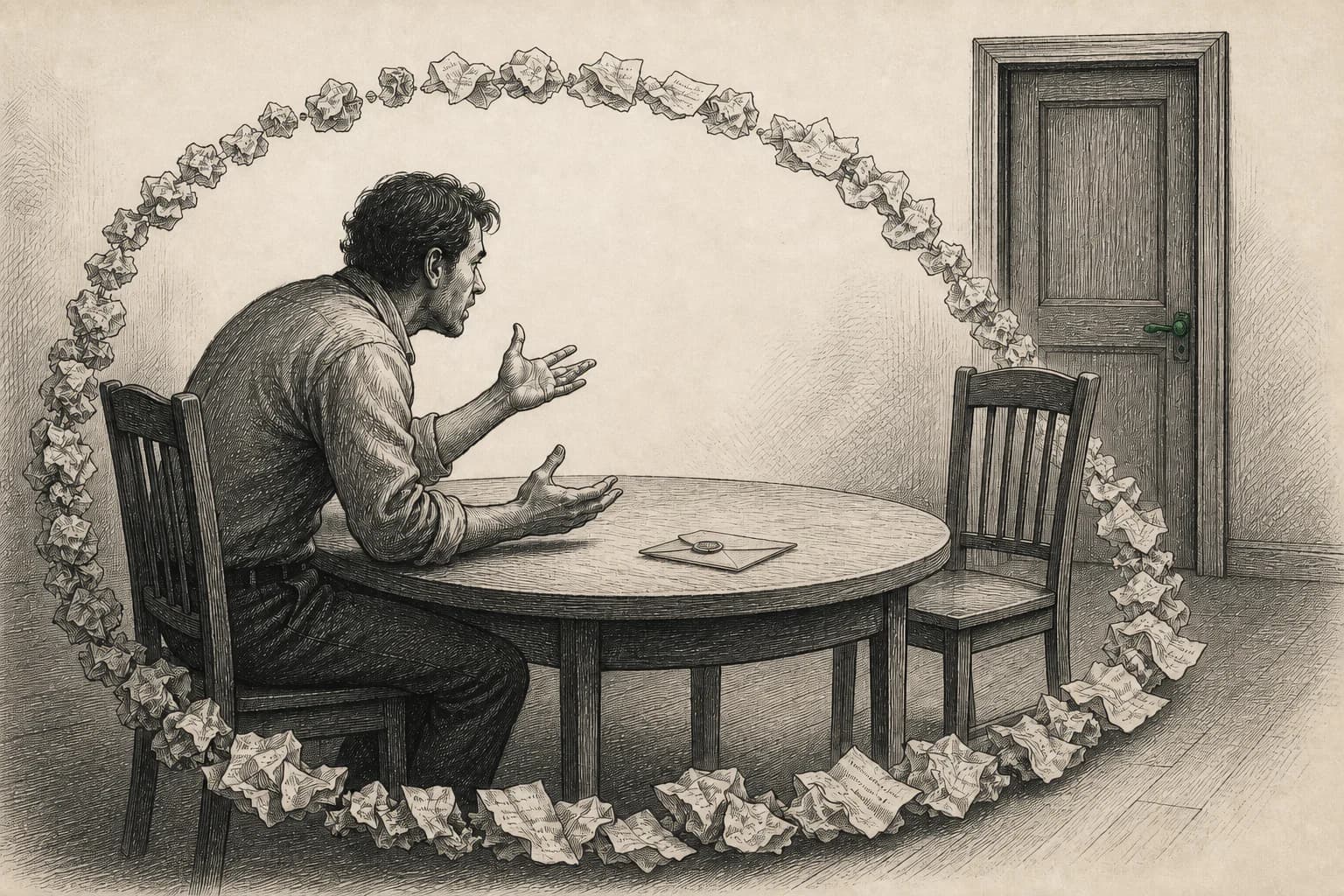
Sometimes a conflict is genuinely unfinished: harm, broken agreements, unpaid money, continuing behaviour or a pending decision.
Sometimes there are no new facts or actions. The person is not solving the conflict; they are reproducing the resentment.
The memory has become a button. Repetition does not complete the event more thoroughly; it only provides another dose of the same response.
Resentment does not always need to be expressed
It is tempting to conclude that everything must be said to the other person.
Sometimes a conversation, demand, boundary or distance is needed. Sometimes the other person is unsafe, absent, dead or incapable of a useful conversation.
Expression is not a compulsory ritual. Someone can say everything and continue resenting, or never speak and complete the old response.
The central question is whether the event still reproduces the state automatically—not whether the other person received a polished speech.
“Erase” does not mean deleting memory
In conversational shorthand I may say, “Erase it and the resentment goes.”
Erase does not mean amnesia.
The event, fact, judgement, right to say no and right to set a boundary remain. What can leave is resentment as continuing emotional charge.
Remembering without being eaten internally is not loss of memory. It is the useful distinction between history and response.
Releasing resentment does not require forgiveness
Some people hold resentment as proof that the other person was wrong.
Emotional suffering is not notarisation of your position.
An action can remain unacceptable without daily suffering. A changed response does not require forgiveness, reconciliation, continued trust or preservation of the relationship.
Sometimes a person stays and renegotiates. Sometimes the boundary becomes firmer. Sometimes they leave. Calm does not have to make the decision softer.
A real unfinished question remains after the response changes
Suppose the old resentment no longer starts, but the money is still unpaid or the behaviour continues.
That is a present fact.
Emotional work does not reclassify debt as imagination, repair another person or make pressure acceptable.
After the old charge reduces, ask what remains and which action is needed: conversation, demand, boundary, distance or decision.
The difference is choosing from today's facts rather than trying to stop internal pain at any cost.
An apology is not a prerequisite
The desire for acknowledgement, apology or repair is real. It is not a necessary mechanism of every resentment nor a condition for completing the response.
Someone may receive an apology and continue the internal argument. Another may never receive one.
My working goal is to test whether the memory still produces the old resentment and separate that from any real matter requiring action.
The result is remembering without living inside the conflict
After the work, the person remembers the event and need not approve it. They can still identify what is unacceptable.
What changes is the state that began eating from the inside each time the scene returned.
Then we test the present: is a conversation needed, does a violation continue, and which boundary will actually be taken into life?
The result is not reconciliation, obligatory forgiveness or a perfect apology. It is that the old conflict no longer needs to continue inside every day.